Showing posts with label Andrew Jacobs. Show all posts

Thursday, November 3, 2022

Why do visuals work?

Rachel Burnham writes: A well-designed visual can be a powerful communication tool, which can be used to inform, inspire and as a guide to action.  They are a useful part of the toolkit for those in organisations, who want to communicate information & ideas, enable learning and support effective performance. 

So often visuals are used for purely decorative purposes – which is fine for plates and tea towels – but is a missed opportunity in learning.  And worse, using visuals purely for decorative purposes can be distracting and get in the way of learning by causing cognitive overload.  However, visuals used purposefully and particularly when used to explain are highly effective.

A well-designed visual can enable you to grasp the key points of a concept or process or practice all at once and also pick up details.   You can ‘see the big picture’ and also components within the main idea and how these fit together – it is ‘computational efficient’ compared to using just a written or verbal presentation.  An example of this is my recent Sketchnote on Psychological Safety, which in a single visual explores what this is, what it contributes too and what leaders can do to support this in their teams. When I shared this recently one person commented that this Sketchnote managed to set out on a single page, what others had taken 15 slides to explain.


The reason a well-designed visual works is that you are able take in all the key information synchronously ie at the same time, whereas written or spoken language is sequential and this requires you to work much harder to link the various pieces of information together. This is known as ‘The Visual Argument’ and comes from the work of Allan Paivio.


In addition, a visual is able to make use of the spatial arrangement on the page to convey elements of the information and we often find this an easy way to take in information, without having to work too hard for it.  For example, items physically closer together on the page are understood to be more closely related; arrows and location can indicate which items come first in a sequence; and bigger items are understood to be more important to physically smaller items.  

A well-designed visual can be particularly useful when you are new to a particular subject, as it helps you to build a mental model of the topic.   As you become more familiar, informed and experienced in a particular field, it becomes easier to build on and adapt your mental models to incorporate further details and nuances because you already have a sense of the area in question and can use your existing mental model as a scaffold to hook new ideas & information onto.  A great visual can help to shortcut this process.

Great visuals can also be useful if reading is not one of your strengths for example if you have dyslexia, or perhaps are working in a language that is not your first language.

Well-designed visuals can be used in many ways.  They could form the basis for a performance support tool – a practical guide to help people do a particular task or activity. They could be used as a way to present information & ideas and be accompanied by prompts to aid reflection & action.   A visual could be used as the basis for a discussion within a team or amongst a group of peers, as an alternative to a presentation.  The visual could be part of a wider package or stand alone.


If you would like to discuss more about how to use visuals effectively to aid learning, why not get in touch?   I am also working with Andrew Jacobs on a free Llarn Learning Clinic on Thursday 24 November 2022 at 11am on this subject – why not book a place? It would be great to see you there.


Rachel Burnham

3 November 2022

I help individuals and organisations to use visuals to think, learn and work more effectively, particularly though using Sketchnoting and drawing.


Sunday, July 7, 2019

Review of 'Curation: The Power of Selection in a World of Excess'


Rachel Burnham writes: I recently read ‘Curation: The Power of Selection in a World of Excess’ by Michael Bhaskar.  Published in 2016, this is an exploration of the very wide way in which ‘curation’ as an approach is being used.  In L&D, many people will be familiar with the concept of curation being applied to how we select, manage and share resources for learning.  You may also have come across the term curation in relation to content marketing, in the context where a marketing strategy makes use of content created by others which is selected and used to promote a particular business – you may even use this yourselves.  And of course, curation, has its origins in the world of museums and art galleries.


Bhaskar looks at curation in many different fields, as a business strategy, in retail, music and many other fields, in governmental regeneration and planning policies and in how we present ourselves as individuals.   He looks at how curation is being used to create value in fields, such as food retail, through specialist food retailers who bring together small niche providers of particular high-quality foods all under a single roof or fascinatingly in the way that a new city is being planned in Abu Dhabi, by curating a cultural district with top museums, art galleries, theatres and music venues. The book is full of examples of curation permeating all sorts of aspects of life – I think he sees curation everywhere – I wasn’t always convinced, though he does a great job of presenting examples to illustrate.

And I found the opening chapters with their emphasis on the abundance of everything for everybody, rather sickening and infuriating – you don’t need to look further than our city centres to see people living without a roof over their head, or open a paper to see the growing demands on foodbanks and that is within the wealthy UK.   But the book did make me think wider about what curation is and how it can be used. 


He describes curation as ‘using acts of selection and arrangement (but also refining, reducing, displaying, simplifying, presenting and explaining) to add value.  I found very helpful some simple diagrams he shares which describe different ways that curating can add value.

Diagram from Pg. 166

He identifies a number of benefits that curation can bring through the way it adds value including:

·         saving time
·         freeing cognitive resources 
·         sparing us anxiety
·         cutting down complexity
·         finding quality 
·         overcoming information overload
·         creating contrast
·         redefining creativity
·         channelling attention
·         providing context
·         beating overproduction. 

One of the most interesting aspects of the book is that looks at both curation through the use of algorithms and also human curation and so it provides insight into our very current concern about how can humans and technology work together. This is sometimes described as ‘thick and thin’ curation.   Where ‘thin’ curation is the network of cataloguing and filtration mechanisms, recommendations and discovery algorithms found throughout the Internet and 'thick' curation is done by humans 'based on detailed personal choices, often for smaller audiences; it discuses its choices and comments on them, adding extra spin to its decisions' (Pg. 233)  Algorithmic curation can keep costs down and make curation scalable, but it is human curation that makes it personalised and personable. I like this quote from Luciano Floridi, Professor of Philosophy and Ethics of Information at Oxford University 

'Curators are experts - you have to have a say to be a curator.  There is a practical side to curation that means algorithmic curation should be joined by a sense almost of ownership or custodianship.  The ability to intervene, to follow on, to ensure your curation has an impact is key.  It is a pragmatic relationship. ' (Pg 229)

What shines through is that effective curation is a highly skilled process.   Bhaskar says in the context of content curation in marketing 'But the term is often used weirdly.  Websites advise people to 'curate in the morning' or curate their way to success. Curation is seen as a shortcut, a defined thing, not a process.  … Good curation is more difficult and subtle than that.' He sees expert selection as at the start of good curation and quotes from Maria Popova, curator of the highly thought of ‘Brain Pickings’:

'The art of curation isn't about the individual pieces of content, but about how these pieces fit together, what story they tell by being placed next to each other, and what statement the context they create makes about culture and the world at large.  This is, she argues, a process of 'pattern recognition'.  Seeing how things fit together, understanding connections (which multiply in a networked environment), but then also, crucially, creating new ones by recombining them, is a massive part of curation.' (Pg 125) 


I love the sense of patchwork which her words evoke, making something new and fresh from scraps of the old or the familiar.  Another word for this would be ‘bricolage’ which Andrew Jacobs has written about.

Bhaskar argues that there are no shortcuts to becoming trusted as a curator – it is about ‘Authenticity, consistency, excellent selections - it is very hard to fake.' (Pg. 210)

I think curation is a useful skill for us to develop both as individuals to aid us in managing the huge amount of information we now need to navigate daily as professionals and also as a skill for us in L&D to share with others and use in our professional practice.   Bhaskar puts it like this:

'The more we understand how curation coheres with a network of new skills, strategies and capabilities, the better prepared we will be for thriving in the age of excess that is changing forever how we live and work.' (Pg. 165)

Rachel Burnham
7 July 2019

I help individuals and organisations to work and learn more effectively, particularly though using the tools of Sketchnoting and the curation of resources.  I make use of Sketchnoting to introduce people to using visuals to aid thinking, working and learning.  I help people to manage for themselves the information they need to stay up-to-date in their professional work.

Sunday, February 10, 2019

More than content consumption


Rachel Burnham writes: Learning is more than consuming content; more than consuming information.  In our information rich world, where there is an abundance of information and content wherever we turn, it is easy to focus on consumption. It is easy to give the impression that more is better.  

It is easy to feel that if only I read more books; kept on top of all my social media feeds; read those journal articles and listened to just one more podcast – then I would be up-to-date, then I would be meeting my own development needs, then I would be role-modelling effective CPD for my colleagues. A counsel of perfection!  Sometimes people share their challenging book reading targets for the year (I’ve written about this before – ‘Read and Relish’) or how they pack in listening to podcasts or audible books in every available space in their lives.  I am not going to pretend to be immune to this.  It can feel like being on a information hamster wheel at times.  Perhaps it is the equivalent for informal learning of the content-dumping sometimes found and decried in formal learning?

But learning is more than consuming yet more and more information.  How do we digest this information, critique it, contrast it with other information, put it into our many contexts, integrate with our current understanding and skills, challenge our thinking and behaviours – how do we sense-make? With all our talk about the abundance of information, ease of access and dangers of feeling overwhelmed, I wonder if we are under-valuing and under-practising sense-making?

I spent some time last year interviewing a number of  professionals, primarily from the fields of L&D and HR, about how they manage the information they need to stay up-to-date in their work.  One of the areas we discussed was this area of sense-making.  Here are some of the approaches they used, plus some of my thinking based on my reading and doing in this area:

A) Bricolage & Curation
Bricolage is a very evocative term that refers to the practice constructing or creating something from a diverse range of other things.  When applied to sense-making, it emphasises linking information from different sources together and looking at the relationships between these different pieces to identify trends, patterns or create new insights and approaches. It is something that Andrew Jacobs has written about on many occasions.  

When curating information or resources, we can use a range of different strategies to do this, such as:

·     Selecting the very best or most relevant pieces and by doing this reducing the noise and adding value for ourselves and others;
·       Grouping information or resources to show the broader picture or pattern;
·       Contrasting information – often there is more than one view on a topic, acknowledging this can deepen our understanding and enable us to be more nuanced in our thinking;
·       Identifying sequences in information eg use of timelines of thought or sequences of activities.

Each of these can help us with sense-making.

B) Mapping & drawing
Many people, even those with very effective digital skills, find it helpful to map out ideas using pen, pencil and paper.  I, of course, very often use Sketchnoting to do this. 

A number of the people I interviewed talked about using paper and pen to draw out ideas and the relationships between them when thinking things through.   Often it can be quicker to rough something out on paper and it can be easy to play with different ways of visualising, testing out approaches, adjusting, rubbing out and trying again. Diagrams can be simple – lots of arrows and basic shapes or more complex.

Whilst the use of pen and paper, doesn’t require drawing skills and pictures, these can allow for the use of metaphors, which can bring in another dimension and stimulate further thinking.  

C) Blogging & writing
Amongst my group of interviewees, probably the key tool in sense-making that they identified was writing.  One commented that ‘To know what I think, I need to write. ’ Writing can take many forms: from handwritten notes, created to capture key information and aid recall; through to writing for reflection, still for personal use; through to writing for sharing either as a blog or for publication in an article or book. 

Once you start writing to share publically, this forces you to clarify your thinking and tests your commitment to what you think.  Clive Thompson in his book ‘Smarter Than You Think’ writes:

‘Audiences clarify the mind even more. Bloggers frequently tell me that they will get an idea for a blog post and sit down at the keyboard in a state of excitement, ready to pour their words forth.  But pretty soon they think about the fact that someone is going to read this as soon as it’s posted.  And suddenly all the weak points in their argument, their clichés and lazy, auto-fill thinking, become painfully obvious.’ (Pg 52)

This is known the ‘audience effect’ and it means that when you are setting out to communicate with someone else, you are forced to think more precisely and with greater clarity.  So this has the advantage of encouraging more effective sense-making.
 

D) Conversation
Another effective aid to sense-making is conversation, whether that is in person or on-line.   It could be as simple as talking through your ideas one to one over a cup of tea, which can help you to clarify what it is you think, but also expose you to other perspectives.

Online conversations can also help with this.  One of the challenges though is that light and shade can be harder to hold onto in an online conversation – trust and listening are just as important as in a face to face conversation, but are often harder to achieve. Some of these online conversations happen in real time such as a Twitter Chat, but they can also take place asynchronously, which can allow for a more reflective approach.  

It is also possible to share online, particularly with Twitter, snippets of insight and practice, which can test out your thinking and gather feedback from others.  This is often referred to as the practice of ‘Working Out Loud’. 

A variant on writing and conversation is to sharing your thinking via a short video, which is also known as ‘vlogging’.  It would be interesting to know whether the ‘audience effect’ also impacts on the quality of thinking when using a video format.  

E) Testing out & Playing
For practical skills, you can’t beat actually having a go at using those skills.   Playing with, testing out, experimenting and then reflecting on this, are all vital aspects of sense-making.  Documenting your experiments is such a valuable contribution to the collective understanding and effectiveness of our profession, but like writing publicly, it can feel like a scary and exposing thing to do.  


Each of these 5 approaches involves reflection.  And underpinning all of that, time and space is essential for sense-making.  

When planning this blog, I searched for a simile or metaphor to capture the importance of this time and space for sense-making.  At first I was drawn to the idea of pools of time for reflection.  But I have settled on the idea of woodland glades. In a forest, with many, many trees close packed together, the dense canopy of leaves can mean that little sunlight reaches the ground and under the trees is a rather sterile environment.  But if a space is cleared and a woodland glade created, where the sunlight can reach through, then all sorts of seeds will germinate and plants grow up and flourish.  A much more diverse and richer environment is created.  This is what sense-making needs.


Let’s make some woodland glades and let the learning flourish. 

Rachel Burnham

10 February 2019

Burnham L & D works with individuals and organisations to help them learn and work more effectively.  As part of this I help L&D professionals to be even more effective through updating their skills and know-how.  I have a particular interest in curation and the use of digital technologies in learning.  I frequently Sketchnote at events and offer workshops in Sketchnoting.  


Friday, July 27, 2018

Pretty in Pink


Rachel Burnham writes:  Whilst talking earlier in the week with Andrew Jacobs about personal curation, lego and learning and many other things, I was triggered to approach an old issue from a different angle. 

I love clothes.  I find fashion fascinating.  I love spotting a trend and I enjoy putting a new outfit together.  But I have learnt that not everything suits everybody and certainly not everything suits me.   Some colours make me glow, and some turn me pale.  Some shapes flatter and some make me feel dumpy.  Some outfits give me confidence to move and work at ease and some stifle and limit.   Not everyone is pretty in pink.  Not every shape of clothes suits every person’s shape.   Not every outfit is suitable for every occasion or this hot weather.


So even if the fashion is for fluorescent neons or crisp white shirts or platform heels I won’t be choosing these.  I love blue denim jeans – they are a classic, ‘timeless’, seemingly loved by everyone – they even come in different shapes and shades.  But I have found they don’t work for my colouring or my shape.  So, I will admire them on others, but find something that works better for me.

And that is a bit like L&D in organisations.   The conferences, blogs and podcasts may be full of some new technology, some new approach to learning or even something that has come full circle and become ‘hot’ again.   But not everything will work everywhere and certainly not everything will be just right for a particular organisation’s needs and current challenges.  So resist the neon leopard platforms and calls to be pretty in pink and find what works for your organisation and do that instead (unless of course neon leopard platforms are just what your organisation needs!).

Rachel Burnham

27/7/18

Burnham L & D works with individuals and organisations to help them learn and work more effectively.  As part of this I help L&D professionals to be even more effective through updating their skills and know-how.  I have a particular interest in curation and the use of digital technologies in learning.  I frequently Sketchnote at events and offer workshops in Sketchnoting.  


Monday, July 11, 2016

Agile Learning - Some Further Reflections


Rachel Burnham writes: At the CIPD ‘Leaders in Learning’ event in Manchester last week, Andy Lancaster invited a group of L&D professionals to consider how we might make our learning design process more agile.  This kind of agility is about being more responsive to the needs of our organisations and the learners we work with, being quicker to develop L&D solutions and perhaps also includes an element of flexibility in what we produce and certainly in the way we produce it.  Here is a link to the Sketchnote I created at the event.

We began by exploring why there is a need for L&D to become more agile in the way we approach learning design.   This is of course related to the pace of change in organisations and in the external environment, which requires organisations to become more agile in order to survive and flourish.   I am sure I don’t need to rehearse again the impact of changes in competition, technology, legislation & regulation, plus the challenges of responding to an uncertain world in the context of global markets, austerity in government policies and Brexit. 

L&D needs to keep pace with this and be able to contribute within our organisations to both to enabling individuals to learn what they need to respond to these changes and also to help individuals and teams become more able to create this organisational agility.   Within L&D, we are often working with fewer resources to meet growing needs.  There are risks if we keep working in traditional ways, with long lead-in times to the design of L&D programmes that we will be too slow to respond to emerging needs within our organisations and/or completely miss out on meeting some needs.  There are risks both to the effectiveness of our organisation and also the credibility and future of L&D in this.


Andy shared with us 10 points to help us to move towards agile learning design.   Here are some further reflections from me on each of these points – I may have paraphrased the wording of some of these 10 points.
1.  Determine business needs as top priority and respond with urgency


This is always important in L&D.  The focus of L&D has to be on improving performance in the organisation and enabling the organisation to better meet its objectives – so I was pleased to see this coming first in this list.

When we discussed how we could overcome challenges about changing our way of working to become more agile, the group I was in identified that focusing on the real ‘pain points in the organisation’ could help to generate sufficient support, particularly from senior managers and other key stakeholders to enable us to try this different approach.   Nick Shackleton-Jones, in a session on learning design at this year’s CIPD L&D Show, talked about identifying ‘what bugs people’ ie what do employees find challenging and gets in the way of them doing their job and then finding ways to address these issues. 


2.  Think big – start small


When trying out a different approach it often helps to try out something on a small scale or using a simpler approach than perhaps you would do normally.   This reduces the risk and can make it possible to get the resources or the ‘go-ahead’ to test out an idea.   I like the idea of running lots of small scale experiments which you learn from rapidly.  This connects to the idea of ‘Working Out Loud’ and testing out ‘half-baked ideas’ publicly –  or at least within your organisation and quickly getting input from other people to refine and add to these ideas. 


Many years ago, I worked for a small organisation that was working out how to do preparatory education on leaving home with young people – a bit like doing health education, but on the subject of housing.   We worked as an action learning project and tried out lots of different approaches to this preparatory education on leaving home and how to get it integrated into youth work and schools.   We were often trying different approaches simultaneously.  As there were only two of us working in the project across the whole of England and Wales –– one of our ‘rules of thumb’ when testing out an idea was to work with people who were already ‘hot to an idea’  ie we would search out volunteers.  Once we had tried out an approach, we would then work with people who were ‘warm’ and who perhaps needed a bit more support, encouragement or even challenging to try something out.


3.  Commit to a speedy development process


This is about our attitudes, but also about making it happen.   It would be worth identifying what causes the particular hold ups in your organisation.  I also think that clearing space in the diary now to be able to start on a new project in this different way would be a good starting point.


4.  Include learners in the heart of the design

I want to ask ‘Aren’t we doing this already?’ and of course we should be, but that doesn’t mean we are.  Often we rely on input from other stakeholders and the voice of learners is overlooked.  If you want to explore this further it is worth looking at Towards Maturity’s work in this area or a recent research report from Good Practice intriguingly called ‘The Secret Learning Life of Managers’.  Both of these pieces of work go far beyond asking learners what they would like and explore how learners learn in practice and what they actually do when they are faced with a challenging task at work.   There is a lot of interest now in developing our understanding of how learners learn effectively and in particular how they use technology to do this – there is the potential to develop this understanding much further through the use of learner analytics. 

But this point, also suggests involving learners in creating their own learning solutions and resources.  And so this also links to point 6 below.


5.  Curation rather than creation

The widespread availability of digital content in many different forms – blogs, video ‘how-to’s, infographics, flowcharts & other diagrams, podcasts (audio files), written guides, sets of FAQs – means that another change in L&D is to curate content rather than needing to create all your own content.   Curation involves searching out relevant materials, selecting the most appropriate, explaining why this has been selected and making this easily available to people who will find it relevant (everything from simply recommending it in an email, through to hosting this selection of resources within a digital platform such as a Learning Management System (LMS) or Virtual Learning Environment (VLE) such as Moodle or Blackboard).

Curating content and only creating content when it is specific to your organisation and not available elsewhere, can contribute to agile design of learning.

If you want to find out more about curation, I would recommend looking at the work of Martin Couzins and he can be found on Twitter @martincouzins.


6.  Create your own low cost content

The wide spread availability of smart phones and access to a range of free or low cost digital tools is making it much easier for L&D professionals to produce all sorts of materials in many different formats.  

This can also be extended to getting learners involved in creating their own content.  This could be through participation in communities of practice, perhaps an online group on the organisation’s Enterprise Social Network (something like Slack or Yammer) or thorough a LinkedIn group or less formal ‘Personal Learning Network’ such as via people connected through Twitter or some other social network.  It could be a colleague creating a useful job aid in the form of a flowchart explaining a process initially produced just for their fellow team members.  It could be a short video clip recorded on a smart phone.  The possibilities are pretty much endless.

Not everything needs to be produced to a Hollywood level of polish and gloss.   Something that is timely and highly relevant to your particular need can have just as much impact. 


7.  Scaffolding social collaborative discussion and learning

This is about using frameworks to provide some support and structure to help people get started in using these approaches for learning at work.  In a way it is an approach to providing a half-way house between a traditional highly-structured approach to a learning programme and a more collaborative approach in which learners have more input and direction of their own learning.   Look out for the work of Julian Stodd if you would like to find out more – he can be found on Twitter @julianstodd.


8.  Don’t be limited by resource availability

One of the potential barriers to agile learning is that we limit ourselves, because we focus on resource limitations, whether that is the availability of rooms, particular trainers or digital resources or finances.  Overcoming the latter was the focus of a session at this year’s CIPD L&D Show ‘Doing More with Less’ with Andrew Jacobs and Stella O’Neill  – here is a link to a Storify of the tweets from this session – look out for session E3.


9.  Learner access any time, anywhere … which includes digital

This is perhaps one of the most challenging areas, as it does require some technical expertise to identify the relevant digital platform for your organisation and situation.   Do take time to think this through.  Take advice.  Think not just about what will work here and now, but what would have some longevity and be sustainable for your organisation.


10.Don’t be a perfectionist – iteratively improve


As an individual this may be one of the most challenging of these tips – I know I always want to have any learning programme I’m associated with to be as good as it possibly can be.  However, that can be at a cost of all the other learning needs that go unmet and the missed opportunities.


As a parent, I have found it valuable to allow myself to not worry about being perfect – I like the concept of the ‘good enough parent’.  I have chosen where to place my priorities as a parent – home cooked food with lots of vegetables and fruit, a bed-time story every night and lots of hugs, but it does mean that the house is dustier than I would ideally like!  In a similar way, we may have to rethink our perfectionism in L&D and decide what can be let go.


These are some of my thoughts on agile learning design.  What does this prompt for you?  What can you being doing differently?


Rachel Burnham

11/7/16

Burnham L & D Consultancy helps L&D professionals become even more effective.  I am particularly interested in blended learning, the uses of social media for learning, evaluation and anything that improves the impact of learning on performance. 

Monday, February 23, 2015

Sweet Spots, Fast Food and Slow Food


Rachel Burnham writes: As you may know I am currently participating in a most interesting MOOC, which is all about social learning.  This blog is being written at the end of week 3 of 4 weeks and we have spent this week thinking about informal & formal social learning.   This is a Working Out Loud blog as I am sharing my learning from this week (and earlier weeks) and make no claims about having completed my thinking on these topics!
 
I have 5 thoughts to share with you from this week’s study:


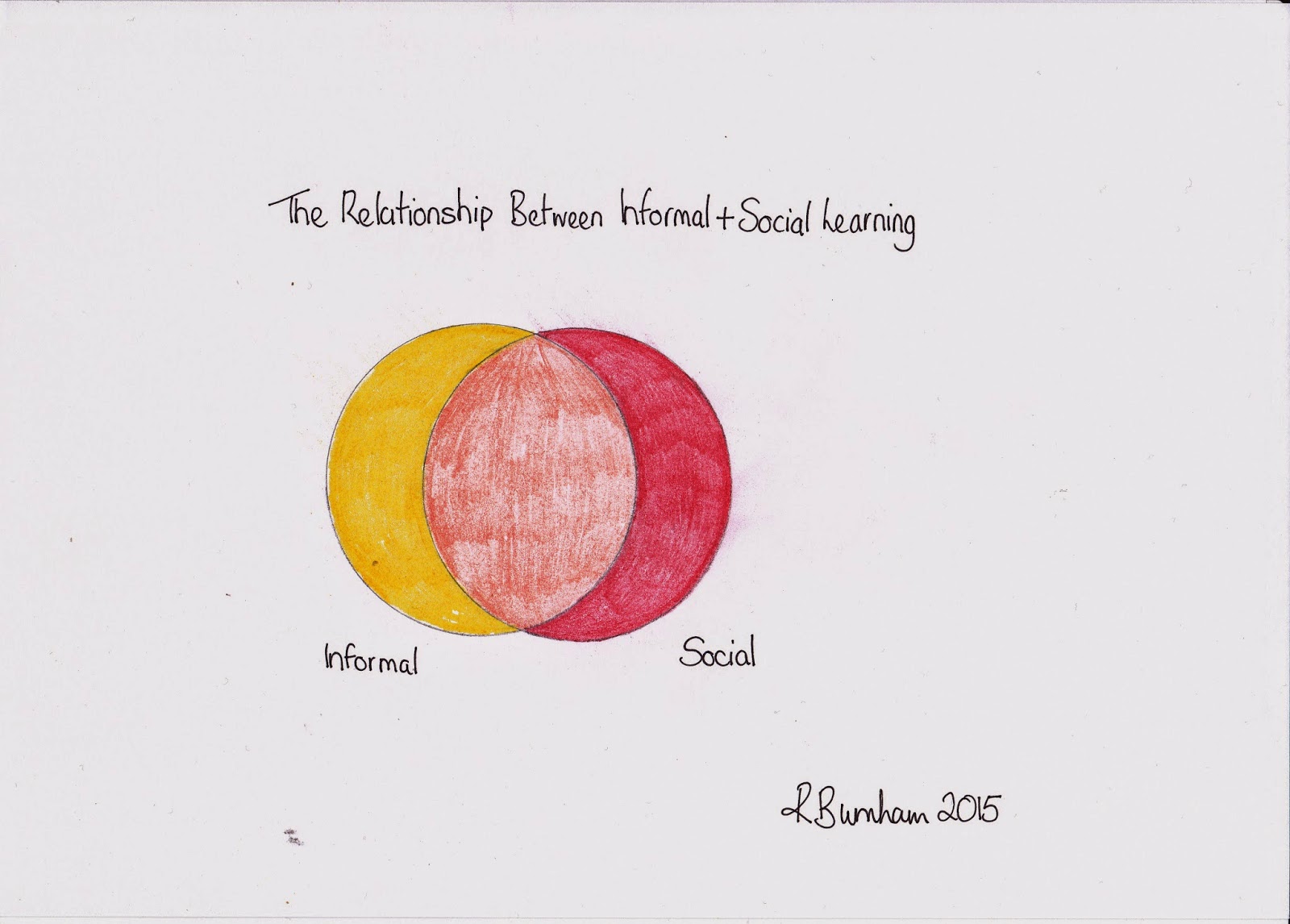
1.  The Relationship Between Informal & Social Learning  

There is a big overlap between social learning and informal learning.  When I use the term ‘informal learning’,  I refer to all those learning methods which are outside of formal learning or education.  A great many of the methods of learning that we describe as informal learning involve social learning ie learning with and from other people.  I recently wrote a blog about informal learning which included a diagram attempting to categorise a range of informal learning methods and if you read the blog, just how many of these methods do also fall under the heading of social learning. This is one of the factors in the confusion that surrounds these terms.


However, it is important to note that not all informal learning involves social learning – there are many ways of learning informally as an individual and I will return to this point latter on.  There are also aspects of social learning that are formal and we can immediately identify workshop based sessions, webinars/virtual classrooms and action learning sets as learning methods that are definitely social but are clearly also formal.


2.  The Relationship Between Informal, Social and Formal Learning


Each of these types of learning has a valuable contribution to make to learning in the modern workplace.  At present too many organisations still rely primarily on formal learning only.  Or rather only acknowledge the part that formal learning plays in the development of knowledge, skills and behaviours for performance at work.  Informal and social learning have always gone on in organisations – people learn by chatting with their colleagues or observing how an effective manager tackles a project or by vowing never, ever to speak to someone in the way that they have just experienced themselves (reflection).  Micheal Eraut spent years studying how people learn in practice and has developed some interesting models which I explore in this previous blog post ‘Lift Off for Informal Learning’.  


The challenge for L&D professionals is to work out how we can most effectively support, encourage and enable informal & social learning in our organisations.  To do that we need to be clear about when each of formal, informal and social is most effective.  It is about making effective choices to suit the context.

We can also combine these through designing scaffolded or guided blended learning programmes as Jane Hart describes them, which combine aspects of the structure of formal learning with the openness, flexibility and individualised nature of informal learning.  Providing access to curated collections of resources which learners are encouraged (but not required to access) can be part of this.  Such programmes can also incorporate opportunities for informal social learning eg through sharing of resources (co-curating) & sharing information/tips/ideas/experiences perhaps through the use of social media. 


3.  Understanding the Value of Social & Informal LearningIt is helpful to appreciate the distinctive benefits of each type of learning to know how best to make use of it. 

Social learning brings with it: 
 
·       Access to information & expertise in a timely fashion
·       Different ideas/experiences
·       Alternative perspectives
·       Opportunity to question & be questioned
·       Opportunity to work co-operatively with others on common issues or problems

Most particularly in the words of Lynda Gratton in ‘The Future of Work’ ‘social will simply become much more important in the future because it fits dynamic learning environments.’

4.  Downsides to Social Learning

The main downside to social learning that I have become aware of is a risk of ‘groupthink’ developing, particularly in social learning environments where there is an absence of critical thinking.   Two factors can particularly affect this I think: social learning in contexts where there is a lack of external contact and secondly, where there is limited engagement with theory.  

In the first case I am thinking about the situation that arises in some organisations where the organisation is very inward facing, perhaps working in silos internally and then further exacerbates this by limiting opportunities for contacts & networking.  This can come in the form of reduced budgets for travel, limited opportunities to step away from operational duties even for short times, discouragement of the use of social media for work use or even an organisational culture that emphasises the distinctiveness & uniqueness of the organisation.  I have experienced this kind of environment occasionally when providing an in-house programme for L&D teams – a culture can develop where social learning leads to the development of clones, where a single idea of ‘best practice’ can be arrived at & then stuck with and a lack of challenge flourishes.  (Just to be clear - I am currently working with an in-house team and my experience is very different with this present team, but this is why I was so keen for each member of the team to have access to a mentor from outside of the organisation.) I think for social learning to be healthy, we need access to a diverse network.


Secondly, for social learning to be healthy and not just some kind of collective folk wisdom, it needs to be tested against theory and particularly evidence based research.   Our practice needs to be informed by theory and the theory needs to keep pace with & in turn be informed by practice – ie  we need to explore praxis rather more consistently than we often do.    


@conmossy shared a very relevant quote as a result of the Twitter Chat on 18/2/15 by Kirk

‘the possession of knowledge without the capacity to effect professional actions of various kinds is pointless; professional action that is not informed by relevant knowledge is haphazard; and knowledge and skills that are not subjected to self-criticism constitute a recipe for professional complacency and ineffectiveness.’  (Kirk, G ‘The Chartered Teacher: A Challenge to the Profession in Scotland’  Education in the North, 11 10-17, 2004)


5.  Social Learning is great, but don’t forget individual learning

In exploring and appreciating the huge value of social learning, let’s not forget that individual learning has its place and value too.   There are many forms of informal learning that are about individuals learning – on their own, at their own pace, thinking their own thoughts and experimenting & reflecting.  Donald Clark in his blog ‘9 Reasons Why I am Not a Social Constructivist’ reminds us of the value of individual learning and also of its particular importance to introverts.  Perhaps I should own up here to my own introversion and how much I enjoy & need time and space on my own as part the way I learn most effectively.   

Sometimes social learning experiences, whether traditional formal approaches or informal approaches can feel rather ‘fast food’ approaches to learning – with their speedy give & take and sometimes little opportunity to slow down, ponder, question and pause.  In those circumstances, I know I struggle sometimes to share deeper reflections or to think critically.  

I think there is a value in more of a ‘slow food’ approach to learning from time to time.  The ‘slow food’ movement is all about food that is cooked from scratch, often using traditional slower cooking methods such as ‘braising’ ‘marinating’ and ‘oven-roasting’, with fantastic fresh locally produced ingredients.  Actually in learning terms, including asynchronous social learning methods, such as discussion forums, which naturally enable opportunities for pause and reflection can be a ‘slow food’ method. 

Adopting more of a ‘slow food’ approach doesn’t mean abandoning social learning, but adopting more of a balanced diet between social and individual learning.  The precise proportions may vary from individual to individual – introverts among us may prefer a slight higher proportion of individual learning, to the extroverts in the population, but we all need both approaches, I would suggest. 

Or we could explore the ideas suggested by Andrew Jacob’s 'Silent Disco' blog and find ways for individual learning at its own pace, but within a social context.  I think that is what we do with blogging – people share their learning individually but by sharing our blogs and then reading & commenting on others we are subtly influenced and learn together. 

As always, I welcome your thoughts and ideas – and feel free to take some time to ponder on them if you would prefer!


Rachel Burnham

23/2/15

Burnham L & D Consultancy helps L&D professionals become even more effective.  I am particularly interested in blended learning, the uses of social media for learning, evaluation and anything that improves the impact of learning on performance.

Follow me on Twitter @BurnhamLandD