Wednesday, June 17, 2020

Sketchnotes from The CIPD Festival of Work June 2020


Rachel Burnham writes: Last week CIPD ran its first virtual Festival of Work with three days of online presentations, panel discussions and Q&A.  I participated in all three days and in some wonderfully inspiring and challenging sessions.

I wasn’t sure whether I would like a fully online conference, particularly over three days, but I really enjoyed it.  I actually much preferred it over last year’s ‘sitting in the dark, with headsets on experience’, which I found profoundly alienating and gave me a splitting headache.  This time it was great to have that ‘sitting in the front row’ feeling.  What I would love CIPD to add to the mix is the chance to chat in small groups with other people about the sessions – I am sure it would be possible to add this.

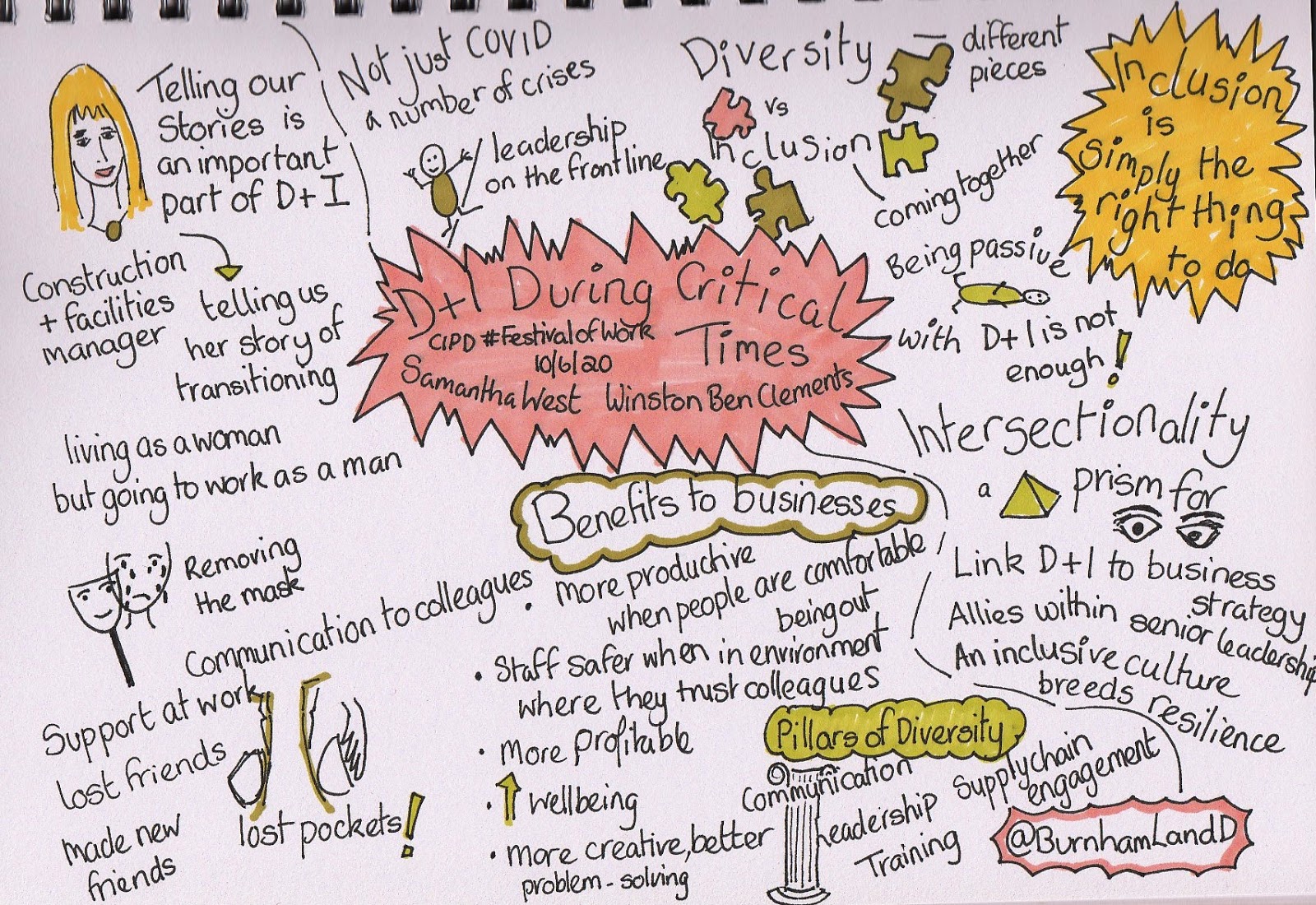
I Sketchnoted my way through all the sessions I participated in and shared the resulting Sketchnotes live on Twitter.  Here is the full collection for any you missed.


Opening Keynote from Prof Andrew Scott

Leading Good Work in Practice Panel 

Business Leadership in an Age of Disruption

D&I During Critical Times

From Course to Learning Experience Panel

Using Cognitive Neuroscience with David Rock 

Humans vs Automation? Dr Hannah Fry 

Agile Methodologies

The Power of Inclusion - Caroline Criado Perez


I hope you find them interesting and useful.


Rachel Burnham

17/6/2020

I help individuals and organisations to work and learn more effectively, particularly though using the tools of Sketchnoting and the curation of resources.  I make use of Sketchnoting to introduce people to using visuals to aid thinking, working and learning.  I help people to manage for themselves the information they need to stay up-to-date in their professional work.

Thursday, March 26, 2020

The many forms of webinars


Rachel Burnham writes: I am working with a client to help them with their transition to making use of webinar/virtual classroom technology to support learning.   

I created the following graphic to help them think more widely about the different ways that webinar/virtual classroom technology can be used, beyond the idea of webinar as a lecture delivered on-line.  I thought it might be helpful to share this more widely. 


The examples I have included aren’t the only possibilities, nor are they intended as ideals, but as prompts for thought.   The way that you use webinar/virtual classroom technology is a design choice and like other design choices needs to be made with the learning & performance need in mind.

I would love to have some feedback on this.

Rachel Burnham

26/3/2020

I help individuals and organisations to work and learn more effectively, particularly though using the tools of Sketchnoting and the curation of resources.  I make use of Sketchnoting to introduce people to using visuals to aid thinking, working and learning.  I help people to manage for themselves the information they need to stay up-to-date in their professional work.


Sunday, March 8, 2020

'Teams' Everywhere


Rachel Burnham writes: At the moment I am seeing and hearing Teams everywhere.  Not ‘teams’ but ‘Teams’, that is Microsoft Teams to be precise.  I am seeing presentations about it, talking about it with friends & colleagues, reading about it and even receiving emails about it (there is an irony here, as Teams is often talked about reducing the need for emails). It is in my work and soon to be in my volunteering. Microsoft Teams seem to be everywhere I look – I think I am having one of those times when having become aware of a topic or product, you suddenly see it everywhere.

If you haven’t yet come across Microsoft Teams, it is  a communication and collaboration tool designed by Microsoft that works alongside a whole array of their other products, particularly Office 365.  There is a paid for enterprise version and also a free version that anyone can download – there are some differences in capabilities between the two.  I’ve heard it described as hub for your work, both with people, within and without your organisation and the software tools that you regularly use.   Or the glue that holds it all together.

It isn’t the only game in town.  There are of course other alternatives available from other providers (I am feeling a little like a BBC presenter at this point) and they each have many common features and their own strengths and weaknesses – I am most familiar with the alternative offered by Slack.  I have no interest in promoting Microsoft Teams over any of these other platforms and tools, it is just that this is the one that has grabbed my attention at this point.  I am not making  a case for this particular product, over any other, but I do want to make the case for using what we have well.  
If your organisation has chosen to adopt Microsoft Teams as it’s chosen platform, then it seems to me that it behoves us in L&D to really get our heads around how the organisation is using it and how we all can make best use of it, including L&D.   We need to be playing our part in seeing how this tool can be used to enable effective performance. That means using it in ways that do not stimulate unhelpful habits (eg like not being able to do ‘deep work’ for constant interruptions through poor use of chat features) nor seeing it as a silver bullet, that can of itself solve major challenges (eg silo working) without doing the other work needed to support this. However, I do think it has a huge potential, if used well, for supporting and enabling behaviours that lead to effective performance, including learning.

My thinking around this was stimulated by this year’s Learning Technologies’ event, where I went along to a presentation which was titled ‘Microsoft Teams as a Learning Platform’.  I was hoping for lots of sharing of ideas and experiences of using Teams to enable learning in the flow of work.   Lots of people turned up for the presentation.  But I was very disappointed by the content, which was very much about using Teams as an LMS and about access to training.  But it made me ponder how else we could be using Teams.  It made me focus on the question ‘If we are working within Teams, why not learn within Teams?’

Anyway, I Sketchnoted the session and as is my habit, I shared my Sketchnote both on Twitter and later on LinkedIn – I received a huge response from people, so many comments, questions and lots of sharing of experience.    Many were sharing that their organisation is adopting Microsoft Teams and they are trying to get their heads around it, some were puzzled about how it can be used to aid learning, others excited by the possibilities but wanting help and support, others were already making use of it to aid collaboration and support learning and shared some of the ways they are doing that.


Two comments in particular stood out for me.  Jo Wainwright shared on LinkedIn ‘I use it because it is where people already are and it already connects to everything else.’   When you are wanting to encourage social and collaborating learning, it is always helpful to consider where people already are – it means you don’t have to work hard to get them there or to overcome barriers to access.   Secondly, Mike Bedford shared on Linkedin ‘…I do not want it to be seen as another wasteful LMS missed opportunity’.   Nor do I!

One of the other people who responded to my Sketchnote was Helen Blunden, @ActivateLearn, who works for Adopt & Embrace, who along with her colleagues has written a book full of advice on using Teams.   I have been reading this with great interest and recommend it to you for providing some great examples of how Teams can be used and a framework for thinking about what is needed for each Team. 


Here are a few quick ideas about how we could be using Microsoft Teams.  Some are my ideas, some have come out of the conversations with colleagues since Learning Technologies, some from my reading and some were shared via social media in response to my Sketchnote – many thanks to all those who have contributed towards my thoughts on this. 

·       You could host a community of practice or a Working Out Loud Circle in a Team and use Microsoft Teams to host the conversations and resources shared.   This can provide a safe space for conversations and exploration of ideas and practices.
·       You could build reflection into every single Team by always incorporating a channel dedicated to ‘Lessons Learned’ or something similar.   Of course setting aside the space, won’t make the reflection happen, but it could provide a mechanism to enable it.
·       You could use the Teams Meeting feature – a video chat feature similar to Skype for Business – to host online coaching or webinars/virtual classrooms.  These can also be recorded, so you could record webinars or walk-throughs sharing your desktop. The features for webinars are not perhaps as fully developed as in other platforms, but can be combined with other tools.
·       You could share resources with colleagues through Teams eg a line manager or a peer recommending an article or video to colleagues.
·       You could curate useful resources as an individual or as a team using either OneNote or a wiki, both of which can be easily linked to a Team.
·       You could create a curated learning programme involving online discussion, reflection and sharing hosted either within a Team or using a wiki.
·       You could help people to find who within your organisation has particular expertise using ‘Who’, a bot that can be utilised.  You could then ask for help from that individual using Chat.
·       You could make relevant performance support tools and resources easily to hand within the relevant Team via a Tab.
·       You could make use of Forms to develop questionnaires and other tools within Teams.  Or use Teams with existing other survey tools eg SurveyMonkey.

I am sure this list is only scratching the surface of the possibilities and of course, it is making these ideas work that is the challenging part.  Encouraging the behaviours and habits of individuals and teams to give these tools and approaches a go.  

Microsoft Teams is just a tool.   We know that it isn’t the tool that is important.  What is important is how we use it to solve the problems that matter to the people we work with and our organisations.


If you are interested in joining me in working together to explore how Microsoft Teams can be used effectively to aid learning and performance, do get in touch.

Rachel Burnham

8/3/2020

I help individuals and organisations to work and learn more effectively, particularly though using the tools of Sketchnoting and the curation of resources.  I make use of Sketchnoting to introduce people to using visuals to aid thinking, working and learning.  I help people to manage for themselves the information they need to stay up-to-date in their professional work.


Friday, February 21, 2020

Collection of Sketchnotes from the Learning Technologies Exhibition 2020


Rachel Burnham writes: Last week on 12 & 13 February I participated in a number of sessions at the Learning Technologies Conference and Exhibition at Excel, London.   As with all exhibitions, the sessions were variable in quality and relevance, some being mere sales pitches and others well informed and thought-provoking.  I have taken the decision to only share my Sketchnotes from the sessions, I found of value or stimulating.

I shared these Sketchnotes via social media during the event and one in particular got a huge response, both on Twitter and on LinkedIn.  It was the Sketchnote of the session on the use of Microsoft Teams for learning – I don’t think it was the session itself, which focused on an add-on to Microsoft Teams, but the idea of using Teams effectively and using Teams for learning really hit a chord.  I think there is huge potential for using Microsoft Teams to aid learning in the flow of work and that is what I think people were responding to.  

I also participated in the launch session of ‘Back to the Future: Why tomorrow’s workforce needs a learning culture’ which is the 2020 annual report from Emerald Works.  Previous years reports were published under the name of Towards Maturity and you may be familiar with them under that name.  Do take a look at this report, there is lots for us to work on in L&D here. Copies of this report can be downloaded from Emerald Works.

Here are my Sketchnotes:


Rachel Burnham

21/2/2020

I help individuals and organisations to work and learn more effectively, particularly though using the tools of Sketchnoting and the curation of resources.  I make use of Sketchnoting to introduce people to using visuals to aid thinking, working and learning.  I help people to manage for themselves the information they need to stay up-to-date in their professional work.


Sunday, February 2, 2020

Skills Development and Deliberate Practice


Rachel Burnham writes: One of the things that has been concerning me for a while in L&D, is that we don’t seem to be paying sufficent attention to skills development. 

In recent years there has been a lot of focus on how we approach the knowledge that people need to be effective in their jobs and a welcome move to making much more use of performance support or resources to address people’s needs and reduce the need for knowledge learning.  There has also been work done on behaviour change through a focus on experience design, habit development and learning transfer.  I made this point in my recent blog ‘5 Ways we could change how we think aboutL&D’. But I think we also need look more deeply at skills development as a profession.

What do we mean by the term ‘skills’?  Here are a couple of definitions of skills that I think are particularly helpful:

‘the ability to do something well, expertise’
Oxford Dictionary

‘the ability to use one’s knowledge effectively and readily in execution or peformance’
Merriam-Webster

Both bring out how important skills are to effective performance, which is what we need to be focusing on in L&D.  Skills take many forms: specific skills for specific jobs – taking blood in nursing, operating precision equipment in engineering, managing conflict amongst neighbours in social housing, advising a client on the best pension options for them, designing the graphics and layout for a textbook; and skills that have more general relevance such as problem-solving, project planning, providing feedback, managing our time, communicating effectively with an upset individual. Skills can be primarily physical skills, interpersonal skills, cognitive skills or combinations of these. Some skills are relatively simple and straightforward, others hugely complex and ones which need to be used in very many variable situations and ways to be fully effective.  Many skills take a long time to develop and hone.  Developing expertise is in part about not only having the skills, but being able to judge when and how to apply them in very different situations.  I think skills are really important to effective workplace performance.

So, I have found myself wondering whether we are giving skills development the attention it deserves, so that we can support this as well as possible within our organisations and the clients we work with.  I think some of the workplace qualifications in wide use don’t sufficiently focus on skills development, over-emphasising knowledge.  Some of the new thinking, around approaches to improving performance in the workplace, provide a needed corrective to traditional education and ‘content-dumping’ approaches, with increased emphasis on performance support or the use of resources and how we engage employees to care for the things that matter to the organisation.  But that still raises questions for me about how best to support employees in developing skills.

I think we could do better.

I had the chance to participate in the eLearning Network’s Connect event in November last year.   One of the sessions I took part in was led by Toby Harris and he was making some related points in his session ‘Beyond the Point of Need’.  Here is my Sketchnote of his session:


He recommended the book “Peak Performance: How all of us can achieve extraordinary things’ by Anders Ericsson and Robert Peel, which describes Anders Ericsson’s years of research into how people in many different fields have achieved outstanding performance and developed their expertise.  


In the book, he identifies ‘deliberate practice’ as the key to this development of expertise and in particular looks at how this leads to the formation of ‘mental representations’ which enable high levels of performance.    Ericsson is very clear in distinguishing what he means by ‘deliberate practice’ and how this differs from the purposeful practice which we may already make use of.  

I have set out in this Sketchnote the key factors which Ericsson uses to describe what ‘deliberate practice’ is:


I think there is much to be gained from exploring the implications of Ericsson’s work.  

It raises lots of questions for me.  For example:
·       What are the most effective ways, that we in L&D can support people to develop their skills?
·       Does it make a difference if they are new to an area of skill or wishing to enhance an area of skill – Ericsson suggests it does?   I want to pay more attention to these kinds of boundary conditions (ie in what circumstances does a particular approach work or not work).
·       What part can formal programmes and self-directed learning play to develop expertise in a particular skill or set of skills, including the use of resources? What might a formal programme look like that is based on ‘deliberate practice’?  How can we encourage & support individuals to use ‘deliberate practice’ in their self-directed learning?
·       How do we help people to develop the ‘mental representations’ that Ericsson suggests are needed for expert performers more speedily and reliably?

I would be interested in hearing from anyone who is already applying these ideas of deliberate practice in their work to aid skills development.

Rachel Burnham

2/2/2020

I help individuals and organisations to work and learn more effectively, particularly though using the tools of Sketchnoting and the curation of resources.  I make use of Sketchnoting to introduce people to using visuals to aid thinking, working and learning.  I help people to manage for themselves the information they need to stay up-to-date in their professional work.

Monday, January 13, 2020

5 Ways We Could Change How We Think About L&D


Rachel Burnham writes: At this time of year, I often curate a set of resources that I think are helpful for developing L&D and enabling L&D professionals to modernise our ways of working.  This year I have decided to do something different and instead take a step back to focus more generally on how we think about L&D.
  
Whilst some in the L&D profession are forging ahead trying out new ideas and experimenting with approaches based upon well-founded research and evidence of what works well, we also are part of a profession that is slow to change. Many continue to use methods and practices that we know are not as effective as they could be - methods and practices that are not meeting the challenges facing organisations or individuals.  

Here are five areas that I think we need to work on as a profession.


1.  Evidence-based

Whilst this approach has been adopted recently by CIPD, there is still a lot of muddle and confusion around about what this really means.   I think getting more in our profession familiar and confident using an evidence based approach can help with three challenges:

·       Tackling the pervasive influence of learning myths around subjects like learning styles, left brain/right brain and so on.
·       Encouraging a focus on effectiveness and what actually makes a difference to performance.
·       Building an appetite for making use of data analytics that is practical in focus.


2.  Looking at a wider range of jobs and sectors

So often the case studies, research and examples explored in L&D conferences, articles and podcasts are from the same rather narrow fields of employment.  It is time that we started to look more broadly beyond the knowledge worker or service sector and also consider the needs of other types of worker, sector and size of organisation.
 
When we are only hearing from this relatively narrow field, important though it is, we risk considering only these needs of these kinds of organisation and that the ideas and solutions presented only are effective in those situations.  If we want to tackle the long tail of L&D that is mostly still only using face to face delivery of content-heavy material, then we have to ensure that our examples, our research, our practices can meet these needs of a diverse range of job roles and organisations.     


3.  Less black and white, more nuance

I think we are running a risk of being too simplistic in some of our thinking about L&D practices.  Of making ‘blanket –judgements’ about ways of working.   ‘This is good’, ‘this is not’.  This is current, up-to-date, the latest thinking and this is not.

For example, I notice in each at the time of the Learning Technologies conference and exhibition a slew of articles about the latest technologies and a corresponding slew of articles defending face to face delivery.  

When it isn’t either or. 

We need to be so much better at being nuanced.  Not just about about the respective values of using technology and face to face, but across the whole field.  It is not helpful to run down the whole of education.  We know that context matters.   So let’s get much clearer about what works when, and in what circumstances, for who and at what point in their career and what the limitations are.   Let’s identify the boundary conditions for approaches, rather than portray each approach as the answer to everything. 


4.  Connect ideas

There are some amazing ideas being developed and explored in L&D.  New ways of working and new (well, newish, in some cases) models and practices.  Many have slightly different focuses and emphasis.   When you begin to be exposed to the range of approaches to performance consulting, models of learning, alternatives to face to face, learning at the point of need or in the flow of work and so on (and also their critiques) – I think a lot of people in our profession, who are new to these approaches can feel overwhelmed and over-faced.  ‘Where are earth do you start?’ 
It would be great to see some more linking up of these ideas, some more comparing and contrasting of them, so that they are not just used piecemeal, but more systematically. We need help to work our way through the thickets of new ideas and research, to weigh up what is of value and work out which ones  link together and are worth taking action on.     

5.  We neglect skills at our peril

I think there is some very interesting thinking around at present about knowledge – mostly about how we make much better use of resources or other performance support tools to reduce the need for knowledge learning.   There is great work on behaviour change around – work on habit formation and learning transfer to support this.   But I think we need to be also paying attention to how to effectively support ‘skills’ development. 


I think we have taken our eyes off this area a bit, yet it is hugely important.  High level skills can be challenging to develop and continue to be important in many areas of work.   Although we critique learning programmes for ‘mere content-dumping’ and a reliance on knowledge transfer done badly, we haven’t really focused much on how to develop complex skills effectively.  Skills that are needed in this wider range of jobs and organisations that I think we should be looking at.  


So, these are the 5 areas, which I think we could usefully focus on, to help shift thinking within our L&D profession, this year.  What do you think?


Rachel Burnham

13/1/2020

I help individuals and organisations to work and learn more effectively, particularly though using the tools of Sketchnoting and the curation of resources.  I make use of Sketchnoting to introduce people to using visuals to aid thinking, working and learning.  I help people to manage for themselves the information they need to stay up-to-date in their professional work.
Friday, November 22, 2019

'Creating a Culture of Curious Learners' eLN Connect 2019

Inspired by the title of this year's eLN Connect - Rachel Burnham


Rachel Burnham writes: On Wednesday 20 November 2019, it was the fifth eLearning Network Connect event in London.  This conference brought together about 180 professionals from the fields of elearning and L&D to explore the theme of ‘Creating a Culture of Curious Learners’.  There were interesting speakers, parallel sessions with participation, facilitated networking sessions, lots of coffee breaks for conversation and chats with exhibitors and even cake.  Big enough to have a variety of sessions and participants, small enough to be friendly and undaunting for the novice.

 It was by far and away the best conference I have been at this year – as in most friendly, thought-provoking and useful.   

I Sketchnoted throughout the event and I am pleased to share my work here:

Opening Keynote from Nicole Bradfield

 
Neusha Milanian - putting some drama into the event


Debating Digital Transformation and L&D's Role


Debating How Leadership can contribute to Creating a Learning Culture


Toby Harris - provoking and making us think seriously about developing skills


I have plenty to mull over as a result of the event and I am sure I will be blogging about this before too long.  And I definitely will be back at future eLN Connect events.

Rachel Burnham
23/11/2019

I help individuals and organisations to work and learn more effectively, particularly though using the tools of Sketchnoting and the curation of resources.  I make use of Sketchnoting to introduce people to using visuals to aid thinking, working and learning.  I help people to manage for themselves the information they need to stay up-to-date in their professional work.