Showing posts with label change. Show all posts

Monday, March 26, 2018

Sketchnotes from CIPD NAP Student Conference 2018


Rachel Burnham writes: It was lovely to have the chance to represent CIPD Manchester at the annual Northern Area Partnership (NAP) conference for CIPD students.  I got to meet lots of interesting students from across the whole of the North of England, from Liverpool to Humberside and from Sheffield to the NE. Why not check out the #CIPD18Student for tweets from the event? 
  
The speakers were excellent and the sessions covered a lot of ground from the ‘Future of Work and the People Profession’,  through to ‘personal resilience’ and ‘developing your networking skills and personal brand through the use of social media’.   Particular highlights for me were hearing the personal stories of Jennifer Hulme about heading up HR in a retail environment and Nicky Ingham sharing her story of developing personal resilience.   I thought the emphasis on the practical case studies in the event was very helpful.  It was good to hear from Mike Collins at River Island on how they have re- shaped Performance Management – which is a very topical issue and one that a lot of organisations are working on currently. 

But the stand-out session for me, was from Lisa Rigby and Helen Baggaley at Wigan Council, with how they approached transforming the culture at the council in the wake of the cuts from austerity measures.  I loved hearing how they decided not to use a ‘traditional training’ approach, but created an experience to engage employees instead.  This was a very unique ‘walk-through’ experience and involved colleagues acting as tour guides through a physical site showing the council ‘past, present and future’.  It included a film room showing videos with popcorn and everyone was encouraged to make pledges about what they would do differently as a result.  This wasn’t a stand-alone programme, but linked to many other supportive steps as well.   It was great to hear about the measurable impact this had.

This approach is very much what Nick Shackleton-Jones argues for - creating an ‘experience’ with an emotional impact and it was great to see this approach being developed as a practical response to addressing the particular concerns and needs within this council.

Here is my collection of Sketchnotes from the event: 


If you are a student studying CIPD courses and didn’t attend this year’s event, do look out for next year’s. 

Rachel Burnham

26/3/18

Burnham L & D works with individuals and organisations to help them learn and work more effectively.  As part of this I help L&D professionals to be even more effective through updating their skills and know-how.  I have a particular interest in curation and the use of digital technologies in learning.  I frequently Sketchnote at events and offer workshops in Sketchnoting.  


Tuesday, November 15, 2016

New Technology: Twas ever thus...?

Rachel Burnham writes: When I was 10 and in the final year at my junior school, we followed a series of television programmes about communication through the ages – I remember enjoying the mix of history and science.  There were two episodes that stood out for me.  The first concerned the puzzle to understand and translate Egyptian hieroglyphs and how the finding of the Rosetta Stone, which contained the same text in three languages: hieroglyphs; demotic script; and Ancient Greek, allowed the former to be translated.  The second was the very final episode which concerned communication in the future - my abiding memory from this, is of people talking to each other at a distance and being able to see other through a device like a television screen.  This seemed like an impossible dream then!  And for years afterwards it seemed to me as though this would always be a fantasy, akin to Star Trek’s voyages.

And as I continued on in education, nothing much seemed to change.  There were no signs of computers at all throughout the whole of the rest of my schooling.  After school I took a year out and worked for the Open University here in Manchester – there I did get to see and even use a computer – of course the OU were and are pioneers in the use of technology – I remember the row of terminals which we used to access student records down the line from the main frame at the OU headquarters.  At university, I was lucky to be able to type all my assignments, unlike most of my peers who had to hand write theirs – on a portable manual typewriter!   We did get to do some computing in one course, where we learnt to write a program to order numbers (if I remember rightly?).    So, nothing much seemed to be changing for a very long time and the idea of talking to someone, whilst seeing them, still seemed an impossible dream.

Working in a series of voluntary organisations in the first part of my career, computers were around, but few and far between.  Then suddenly we all had one, and they were networked, and overnight everything changed.  The future happened all in a rush!  Now what once seemed an impossible dream is a daily commonplace and computers pervade every aspect of our lives, not just work.  And this technology is changing and developing constantly.

At this week’s CIPD Annual Conference I attended a number of sessions which explicitly focused on work and the future – the theme of the conference.   My Sketchnotes from the conference can be found in a previous post.  In one of these sessions Dr Almuth McDowell and Dr Richard Mackinnon discussed with David D’Sousa ‘Digital Work’.  They began by focusing on now, rather than the future, partly because we are so bad at predicting the future, but also because now is just so interesting – there is so much happening right now, that we need to get our heads around.   Though Richard Mackinnon reminded us that all through the 60’s and 70’s people commented on the huge pace of change and the way that technology was central to this, so this isn’t new.   So, perhaps this has always been the case down the ages as each ‘new technology’ has been introduced – for that generation, for that age, the change was huge.  May be these changes feel huge to us, because they are our changes – the changes and the challenges for our generations.


This panel talked about the way that technology was replacing some jobs and at the same time leading to the creation of new jobs.  Whilst other jobs are transforming from one thing to something very different eg fighter pilot to drone pilot.  These sorts of changes have many implications in terms of the cognitive requirements of jobs, the implications for managing the ethics of this and how to help people to learn & develop into these changing roles.  The panel identified a series of skills that will continue to be vital for the future amidst all this change such as adaptability, resilience, problem-solving, emotional intelligence and not information, but where & how to find it.

In a similar vein, Daniel Susskind spoke about technology and the future of the professions.  This was based upon the research that he and his father have carried out and written up in their book ‘The Future of the Professions’.  Based on his session, I would highly recommend reading this book. 

He explored with us why we have professions and why they are challenged by the way that technology is developing.  He identified that the professions are facing four key challenges: cost; antiquated ways of working; opaque ways of working and simply underperforming.  It is clear that there are massive changes afoot for a great many professions and that these changes are already here and happening now.

Linking back to the previous session, if we had been called on to predict which jobs would be affected by technology, we would most likely have focused on low skills jobs being replaced by automation.  However, Susskind, explored the ways which technology is affecting professional work, so that high skilled roles are being replaced by lower skilled roles supported by technology.  For example, rather than a specialist doctor needing to diagnose a condition, a nurse (so still a skilled role, but not so specialist a role) could undertake this, when supported with technology to aid diagnosis - with the possible additional advantage to the patient, that the nurse has the people and empathetic skills lacking in many doctors.

Susskind explained that one of the reasons we have found it so hard to predict how technology can develop, is that we have often assumed that machines will need to tackle tasks in the way that humans do.  When actually they don’t.  Once this mental hurdle had been crossed, there have been found many ways of using technology to tackle tasks that could previously only be done by skilled people. 

Actually, it occurs to me, that actually not only do machines not need to do things in the way we have done them, neither do we.

Which brings me, to the final keynote of the conference, which was delivered by Gianpiero Petriglieri, from INSEAD on leadership.  He was exploring why leadership is about more than just competences, particularly in what he called this ‘age of nomadic professionalism’.  He discussed that way that effective leaders make us feel and that involves ‘a cocktail of skills and passion’.  He spoke about how effective leaders create meaning for others through the way they convey and live a story which converts anxiety to hope.  He spoke of how they are prepared to sacrifice for that story.  He looked at leadership as having two aspects of performance – achieving aims, but also embodying shared values.  So he was suggesting that leadership does not need to be done as it has been done in the past.  He defined global leadership now as:


‘the courage, capacity, curiosity and commitment

to

work with, learn from and give ‘voice’ to the other’.


This was a hopeful and inspiring note to close the conference on.   We need courage, capacity, curiosity and commitment to respond to the changes that our world and our workplaces are facing both from technology and the other economic and political challenges.  We will need to hear and work with other ‘voices’ to do that.  This view of leadership is very different to that which most of us have experienced in the workplace to date – and it seems a very long way from the model being expressed in the political sphere at present. 

There are challenges a-plenty for us all here, whether in relation to digital work, the impact of technology on professions, including our own and the kind of leadership that is needed.  And the future is here and now!

Rachel Burnham

15/11/16

Burnham L & D Consultancy helps L&D professionals update and refresh their skills.  I am particularly interested in blended learning, the uses of social media for learning, evaluation and anything that improves the impact of learning on performance. 


Wednesday, July 23, 2014

Butterflies, Stories, Change, Jazz


Butterflies, Stories, Change, Jazz


Rachel Burnham writes: Ever since I saw a wonderful photograph of a butterfly taken by Doug Shaw at the weekend and was in turn encouraged by him to photograph the ones at our allotment, I can’t get butterflies out of my mind.  Their wonderful flowing shapes, the variety of colours and patterns, the way they move, the contrasting textures between wings and body.  Butterflies on the brain!

And of course, it isn’t just their shape that inspires and entrances – they are so evocative in the way they represent ideas of change, personal growth and transformation.  It is easy to connect with butterflies – many of us will have as children folded a sheet of paper in two, placed splodges of paint and amazingly a butterfly emerged. Or again folded a paper in two and cut shapes out to create an outline of a butterfly.  Some of us may have repeated the process with our own children. You, like me, may even have studied the life cycle of the butterfly in Biology lessons.

I have my own butterfly story.  Many years ago, I represented the United Reformed Church at the Assembly of the World Council of Churches – it was a wonderful experience.  One of the things I remember from it was a huge artwork that hung at the back of the Assembly hall – it was an enormous patchwork made up of many, many pieces each made by a different church congregation in the host country, all illustrating the theme of the event.  At the close of the Council, the pieces were all untied and each one given to a delegate to take back to their own church.  My piece for my then church at High Cross, Tottenham was a beautifully appliqued butterfly – in this case representing ‘New Life’ or ‘New Beginnings’.

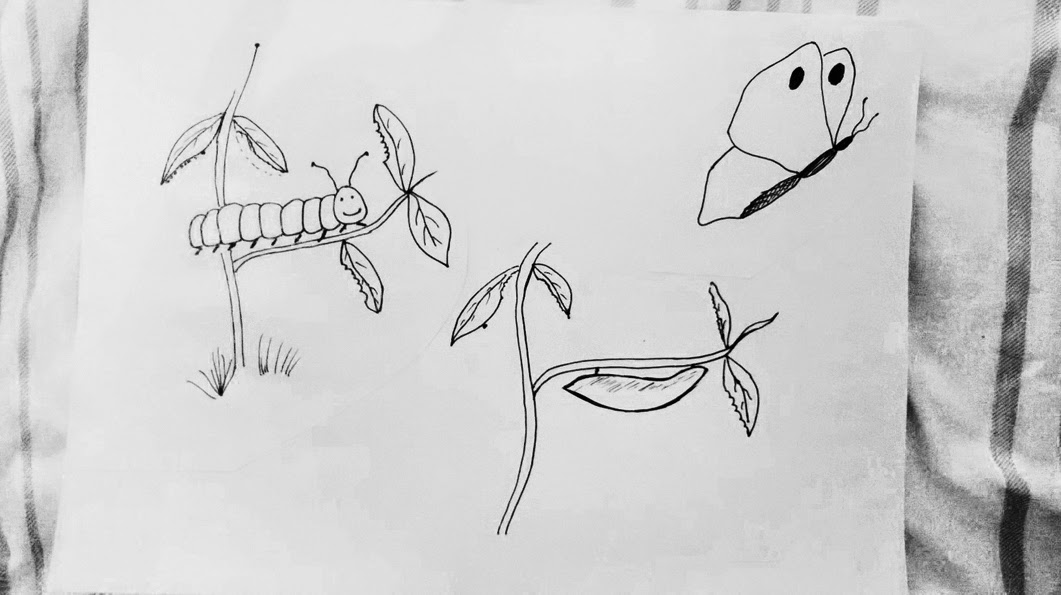
My three part drawing of this life cycle tells a story.  But looking at it now I can see many stories within it.  


It could be the story of the many CLDP students that I work with.  Coming to the programme hungry for knowledge, development and keen to develop their skills.  The pupa could be the reflection that they engage with during the programme.  And I certainly know many butterflies who have emerged & stretched their wings to go off and explore the world of L&D.  I am lucky to hear from many ex-students who continue to stay in contact and share their stories with me.

The butterfly’s story could be another way of looking at Harold Jarche’s Seek-Sense-Share model for PKM (Personal Knowledge Mastery).  The caterpillar is clearly in full ‘seek’ mode – curious & hungry - eating its way through all sorts of interesting blogs, tweets, posts, shares and likes.  Whilst in its cocoon, the pupa ‘senses’, filters, combines, contrasts, discerns before emerging to ‘share’ its unique wing patterns and take on the world.

Or it could be the story of my career – a keen & eager young L&Der devouring books, trying out new approaches – a very hungry caterpillar! Then feeling cocooned by the experience of motherhood and that desperate need to balance out competing priorities – safety, the need to earn and a limiting of professional challenges winning out.  But now – a new phase is entered on and I’m getting to spread my wings again!

What stories do you see in the butterfly’s experience?

Which brings me to jazz! Some years ago, I borrowed Toni Morrison’s novel ‘Jazz’ from my brother.  I thought it was going to be about jazz.  Then part way through, I had a Homer Simpson moment ‘Duh!’ – it wasn’t about jazz – it was jazz!  Toni Morrison had structured the novel just like a piece of jazz music, with the opening chapter providing an outline of the main elements of the story – the ‘head arrangement’ or ‘theme’ and then each subsequent chapter elaborating & improvising on this theme from the perspective of each of the key characters – a trumpet solo, sax solo, even the dreaded drum solo – if you like.  Just like with a piece of jazz music, we all have our own interpretations of our experiences or stories – sometimes we share an experience with friends, but still have our own perception of that story.  

That happened to me only this week.  In the course of a conversation, I suddenly felt the ground shift, bit like a minor shock from an earth tremor, as I suddenly shifted perspective and caught a glimpse of the world from another’s perspective.  A whole different story to mine.  Just for an instance.   

And as I reflected on this, I was able to see a new story for me.  I had been telling myself the story of my last few months in a particular way – with a particular narrative theme – it’s been a tough 18 months personally - but I could now hear it in a new way too.  A more resourceful, positive way. Like a jazz musician returning to a classic tune and finding new patterns, new depths, new ways of playing it.   

Like jazz musicians, we don’t have to play the same tunes in the same way – it is possible to do differently, improvise and hear fresh sounds.  We write our own music.

Butterflies.  Stories.  Change. And jazz!

Rachel Burnham
23 July 2014

Burnham L & D Consultancy helps L&D professionals become even more effective.  I am particularly interested in blended learning, the uses of social media for learning, evaluation and anything that improves the impact of learning on performance.
Follow me on Twitter @BurnhamLandD