Showing posts with label Paul Matthews. Show all posts

Thursday, October 11, 2018

As a line manager how can you help your team members to learn?


Rachel Burnham writes: Last Friday I was preparing a session for a group of managers I am supporting through a CMI programme and I was thinking about practical things that they could do to support their team members to learn.   Of course, I started to think how could I present this in a Sketchnote.   And then I realised how much better this would be if I asked for contributions from my Personal Learning Network (PLN), so I shared this idea via Twitter. 

I received lots of contributions through the day and then put my Sketchnote together at the end of the working day.   However, the original tweet got retweeted several times and ideas kept coming in throughout the weekend.  I hate to waste a good idea, so I curated these into a Twitter Moment.  

As an aside, Twitter Moments are a great tool for gathering together a few Tweets - they are very easy to use and you can keep adding to them before you publish, so they are very useful for situations when you want to keep a whole Twitter conversation, but perhaps a Wakelet isn't required.  It made me realise I could make more use of Twitter Moments.    

The Sketchnote and Moment have been shared a lot over the course of the last week, so I thought it would be sensible to include them within my blog.  And here they both are – with many, many thanks to all who shared their ideas:


Here is the Twitter Moment.


I will put a larger version of the Sketchnote at the very end of this post. 


Rachel Burnham

11/10/18

Burnham L & D works with individuals and organisations to help them learn and work more effectively.  As part of this I help L&D professionals to be even more effective through updating their skills and know-how.  I have a particular interest in curation and the use of digital technologies in learning.  I frequently Sketchnote at events and offer workshops in Sketchnoting.  


Monday, February 23, 2015

Sweet Spots, Fast Food and Slow Food


Rachel Burnham writes: As you may know I am currently participating in a most interesting MOOC, which is all about social learning.  This blog is being written at the end of week 3 of 4 weeks and we have spent this week thinking about informal & formal social learning.   This is a Working Out Loud blog as I am sharing my learning from this week (and earlier weeks) and make no claims about having completed my thinking on these topics!
 
I have 5 thoughts to share with you from this week’s study:


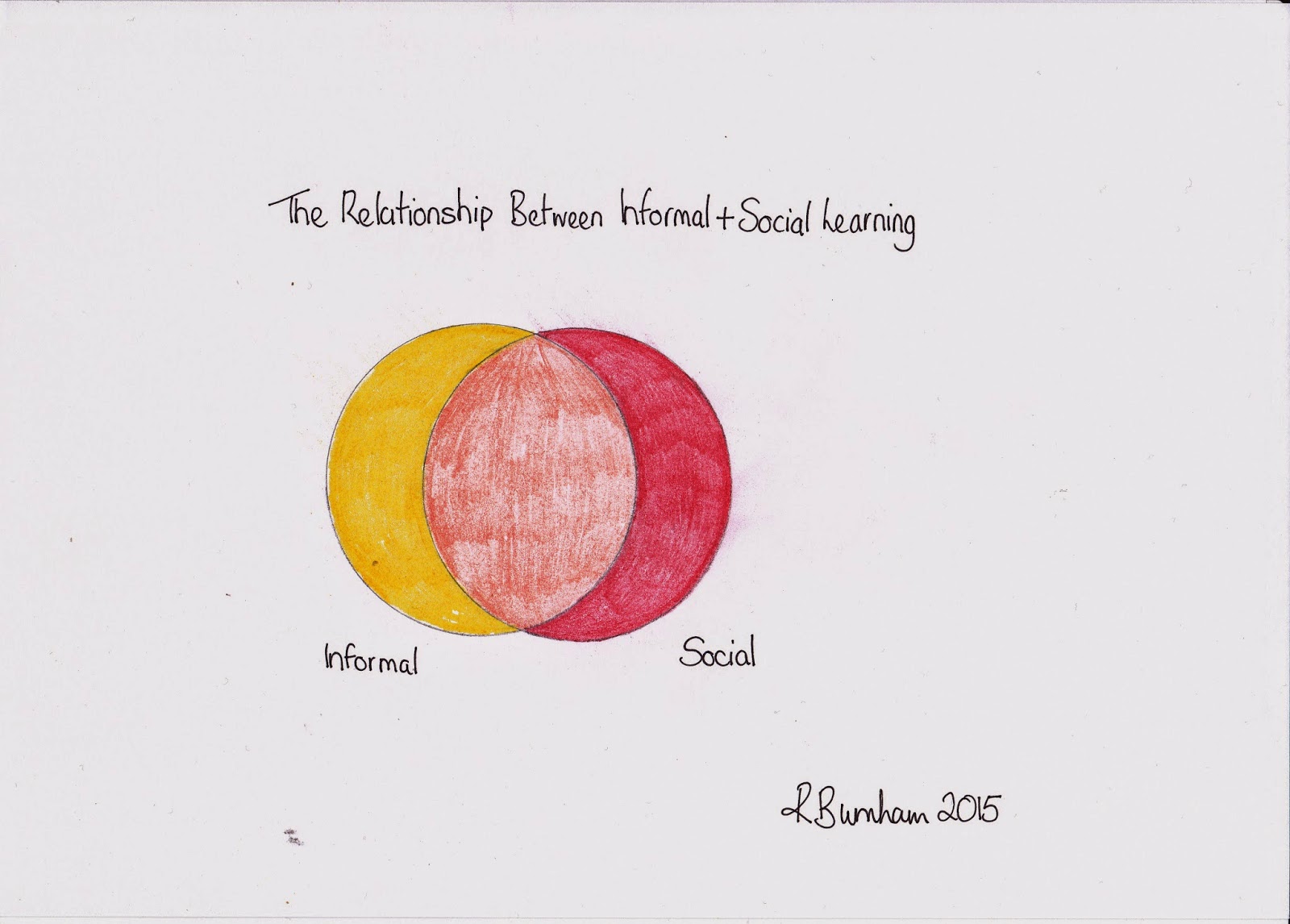
1.  The Relationship Between Informal & Social Learning  

There is a big overlap between social learning and informal learning.  When I use the term ‘informal learning’,  I refer to all those learning methods which are outside of formal learning or education.  A great many of the methods of learning that we describe as informal learning involve social learning ie learning with and from other people.  I recently wrote a blog about informal learning which included a diagram attempting to categorise a range of informal learning methods and if you read the blog, just how many of these methods do also fall under the heading of social learning. This is one of the factors in the confusion that surrounds these terms.


However, it is important to note that not all informal learning involves social learning – there are many ways of learning informally as an individual and I will return to this point latter on.  There are also aspects of social learning that are formal and we can immediately identify workshop based sessions, webinars/virtual classrooms and action learning sets as learning methods that are definitely social but are clearly also formal.


2.  The Relationship Between Informal, Social and Formal Learning


Each of these types of learning has a valuable contribution to make to learning in the modern workplace.  At present too many organisations still rely primarily on formal learning only.  Or rather only acknowledge the part that formal learning plays in the development of knowledge, skills and behaviours for performance at work.  Informal and social learning have always gone on in organisations – people learn by chatting with their colleagues or observing how an effective manager tackles a project or by vowing never, ever to speak to someone in the way that they have just experienced themselves (reflection).  Micheal Eraut spent years studying how people learn in practice and has developed some interesting models which I explore in this previous blog post ‘Lift Off for Informal Learning’.  


The challenge for L&D professionals is to work out how we can most effectively support, encourage and enable informal & social learning in our organisations.  To do that we need to be clear about when each of formal, informal and social is most effective.  It is about making effective choices to suit the context.

We can also combine these through designing scaffolded or guided blended learning programmes as Jane Hart describes them, which combine aspects of the structure of formal learning with the openness, flexibility and individualised nature of informal learning.  Providing access to curated collections of resources which learners are encouraged (but not required to access) can be part of this.  Such programmes can also incorporate opportunities for informal social learning eg through sharing of resources (co-curating) & sharing information/tips/ideas/experiences perhaps through the use of social media. 


3.  Understanding the Value of Social & Informal LearningIt is helpful to appreciate the distinctive benefits of each type of learning to know how best to make use of it. 

Social learning brings with it: 
 
·       Access to information & expertise in a timely fashion
·       Different ideas/experiences
·       Alternative perspectives
·       Opportunity to question & be questioned
·       Opportunity to work co-operatively with others on common issues or problems

Most particularly in the words of Lynda Gratton in ‘The Future of Work’ ‘social will simply become much more important in the future because it fits dynamic learning environments.’

4.  Downsides to Social Learning

The main downside to social learning that I have become aware of is a risk of ‘groupthink’ developing, particularly in social learning environments where there is an absence of critical thinking.   Two factors can particularly affect this I think: social learning in contexts where there is a lack of external contact and secondly, where there is limited engagement with theory.  

In the first case I am thinking about the situation that arises in some organisations where the organisation is very inward facing, perhaps working in silos internally and then further exacerbates this by limiting opportunities for contacts & networking.  This can come in the form of reduced budgets for travel, limited opportunities to step away from operational duties even for short times, discouragement of the use of social media for work use or even an organisational culture that emphasises the distinctiveness & uniqueness of the organisation.  I have experienced this kind of environment occasionally when providing an in-house programme for L&D teams – a culture can develop where social learning leads to the development of clones, where a single idea of ‘best practice’ can be arrived at & then stuck with and a lack of challenge flourishes.  (Just to be clear - I am currently working with an in-house team and my experience is very different with this present team, but this is why I was so keen for each member of the team to have access to a mentor from outside of the organisation.) I think for social learning to be healthy, we need access to a diverse network.


Secondly, for social learning to be healthy and not just some kind of collective folk wisdom, it needs to be tested against theory and particularly evidence based research.   Our practice needs to be informed by theory and the theory needs to keep pace with & in turn be informed by practice – ie  we need to explore praxis rather more consistently than we often do.    


@conmossy shared a very relevant quote as a result of the Twitter Chat on 18/2/15 by Kirk

‘the possession of knowledge without the capacity to effect professional actions of various kinds is pointless; professional action that is not informed by relevant knowledge is haphazard; and knowledge and skills that are not subjected to self-criticism constitute a recipe for professional complacency and ineffectiveness.’  (Kirk, G ‘The Chartered Teacher: A Challenge to the Profession in Scotland’  Education in the North, 11 10-17, 2004)


5.  Social Learning is great, but don’t forget individual learning

In exploring and appreciating the huge value of social learning, let’s not forget that individual learning has its place and value too.   There are many forms of informal learning that are about individuals learning – on their own, at their own pace, thinking their own thoughts and experimenting & reflecting.  Donald Clark in his blog ‘9 Reasons Why I am Not a Social Constructivist’ reminds us of the value of individual learning and also of its particular importance to introverts.  Perhaps I should own up here to my own introversion and how much I enjoy & need time and space on my own as part the way I learn most effectively.   

Sometimes social learning experiences, whether traditional formal approaches or informal approaches can feel rather ‘fast food’ approaches to learning – with their speedy give & take and sometimes little opportunity to slow down, ponder, question and pause.  In those circumstances, I know I struggle sometimes to share deeper reflections or to think critically.  

I think there is a value in more of a ‘slow food’ approach to learning from time to time.  The ‘slow food’ movement is all about food that is cooked from scratch, often using traditional slower cooking methods such as ‘braising’ ‘marinating’ and ‘oven-roasting’, with fantastic fresh locally produced ingredients.  Actually in learning terms, including asynchronous social learning methods, such as discussion forums, which naturally enable opportunities for pause and reflection can be a ‘slow food’ method. 

Adopting more of a ‘slow food’ approach doesn’t mean abandoning social learning, but adopting more of a balanced diet between social and individual learning.  The precise proportions may vary from individual to individual – introverts among us may prefer a slight higher proportion of individual learning, to the extroverts in the population, but we all need both approaches, I would suggest. 

Or we could explore the ideas suggested by Andrew Jacob’s 'Silent Disco' blog and find ways for individual learning at its own pace, but within a social context.  I think that is what we do with blogging – people share their learning individually but by sharing our blogs and then reading & commenting on others we are subtly influenced and learn together. 

As always, I welcome your thoughts and ideas – and feel free to take some time to ponder on them if you would prefer!


Rachel Burnham

23/2/15

Burnham L & D Consultancy helps L&D professionals become even more effective.  I am particularly interested in blended learning, the uses of social media for learning, evaluation and anything that improves the impact of learning on performance.

Follow me on Twitter @BurnhamLandD


Wednesday, December 10, 2014

Informal Learning - Search for a Pattern


Rachel Burnham writes: I had the pleasure of reading through Paul Matthew’s ‘Informal Learning at Work’ earlier in the autumn as part of the preparation for an earlier post about informal learning.  

Informal learning refers to learning that is outside of formal training or education and is a type of learning that has always been around, but is of growing interest & importance to organisations and L&Ders currently. 

I was particularly struck by the wide range of different methods of informal learning which Paul Matthews sets out in the fourth chapter.   These are illustrated by a set of excellent practical examples.   There were so many different types of informal learning contained within the chapter that I found myself overwhelmed and unable to get an overall sense of them.  What I needed was a visual!

So, I decided to have a go at grouping these learning methods and creating a diagram to illustrate them.  Paul Matthews warns in the chapter that the methods ‘don’t fit nicely under simple headings’ (Matthews, P 2013 76) and I know now that this is true.  But I have still given it a go – see what you think?


I have begun at the centre of the diagram and a group which I have titled ‘Starting with the Individual’ – these are all methods which an individual can initiate for themselves, no matter what else is going on in your organisation.

The second grouping and much the most numerous, focuses on informal learning methods that are essentially ‘Person to Person’ and primarily one person to one person, such as coaching, shadowing, asking colleagues – they all seem to have conversations at their heart.

There is an undeniable blurring across to the next grouping, which I have called ‘Learning in Groups’.  I have put social learning here – but this could also apply to ‘Person to Person’ and some of the other categories.  Here you find learning methods that are all about learning with many other people – of course not necessarily face to face.

In the bottom right hand of the diagram, I have placed a couple of approaches to learning that relate to ‘Management Style’ and I am sure that others could be added here.  For example, it seems to me that delegation could be usefully included here.

In the centre of the bottom of the page, I have collected together a number of ‘Resource-based Approaches’ which include help-desks, on-line help and various kinds of content provision.

The divide between ‘Resource-based Approaches’ to the final grouping of ‘Social Resources’ is so weak, that I have shown this as a broken line.  The distinction for me is that for the Social Resources, the format may be provided & supported by the organisation, but the content comes from learners themselves.  Whereas with ‘Resource-based Approaches’ the organisation is in control of the content.  These ‘Social Resources’ may be integrated in with content provision sourced from elsewhere,  but they do have distinctive features because of their home-made ‘socially generated’ content and therefore they also link with the ‘Learning in Groups’ category.

I took the decision to exclude ‘appprenticeships’ from the diagram, although it does appear in Paul Matthew’s list – I felt that in their current format in the UK these are more formal than informal and so decided not to include them.

I have found this a useful exercise to help me get my head around some of the range of possible methods within the area of informal learning.  I would be most interested in your views on this.

And do read ‘Informal Learning at Work’ if you haven’t already done so!

Rachel Burnham
10/12/14

Burnham L & D Consultancy helps L&D professionals become even more effective.  I am particularly interested in blended learning, the uses of social media for learning, evaluation and anything that improves the impact of learning on performance.

Follow me on Twitter @BurnhamLandD