Wednesday, August 27, 2014

My Learning About Webinars


Rachel Burnham writes: I have been wanting to write about my experience of working with webinars for some time, mainly because I want to pull together my learning for my own benefit, but I have decided to share this.  


The allotment - definitely a work-in-progress - just like me & webinars!


First Experience

My first experience of participating as a guest speaker in webinar was about 5 years ago and of course there are lots I don’t remember about that experience.  I do remember a thoughtful & helpful practice with using the technology, a couple of hours before the session, supported by a technical specialist that made all the difference to my confidence. I do remember feeling less prepared for how the content all worked together, as I only had a small 5 minute slot in a 75 minute session and wishing I had sight of a session plan, rather than just the powerpoint slides that were being used.  

What I remember from the delivery of that session was just how truly weird it felt to be speaking to a group of people, but with no visual feedback from them at all – I particularly remember how peculiar it felt to not make eye contact.  On that occasion, there was little feedback through the chat-box, so there was an absence of much feedback at all.  But the other aspect that made it a very strange experience, was that I was also cut off from the other presenters & facilitators – for some reason I had decided to switch to using the Mac, rather than my PC and found to my dismay that it didn’t support many of the features that I had practiced using in the technical run through earlier that day – so I had no access to the chatbox myself and couldn’t even ‘raise my hand’ to attract the attention of the lead facilitator.  Note to self – practice on the equipment you will be actually using.  A limited & limiting experience.  But I was asked back to do more guest slots, so I knew I needed to learn more about webinars.

Participating in Webinars

At some stage I adopted the approach of signing up to participate in lots of different webinars in order to learn about what was effective practice and to build my own experience.  I had noticed that they were becoming a learning option used by more organisations and wanted to make sure I was keeping up with this growing practice.   I probably had begun to do this prior to my first experience as a guest speaker, but I certainly hadn’t participated in more than a couple before to this experience.  So now I started to participate with more of a pressing need.

I participated in free sessions offered by the providers of various webinar/virtual classroom technology; sessions offered by my former university by visiting speakers; and sessions delivered by a number of ‘expert’ presenters – ‘expert’ in their topics or in webinars.   Some sessions involved a single facilitator, some a panel, some a facilitator & also a guest speaker.  The level of interaction with participants varied tremendously between the sessions and my experience was that the most effective sessions were the more interactive sessions.  All of these webinars involved some use of slides, but some used a range of other tools as well.   

One of the sessions from Aston University made use of a video camera, alongside very visual slides and this gave this session the feel of an expert & effective lecture - just delivered at a distance.  There was opportunity to put questions to the presenter, who gave them time & attention. It was great being able to see the speaker – the visual made them seem more real.  Other sessions had incredibly lively chatbox discussions going on throughout the session, in which participants posed questions, answered them, challenged the speaker, challenged each other – this was when I first became aware of the learning power & vitality of a ‘backchannel’ alongside the formal learning delivery.

One session, which was focused on how to design & deliver interactive webinars, was great for demonstrating a range of tools for doing that – it really delivered on its promise.  During the session polls, whiteboards, the chat box were all used effectively.  But we also got to do some things that had never occurred to me before in the context of a webinar – such as drawing pictures and then discussing what we had drawn (and as I love to draw, this really fired my imagination). 

It became clear to me that webinars have the potential to take a number of different formats and be effective.  I also realised that the typical format of a webinar of a talk supported by powerpoint, can be made much more effective by applying many of the same design principles as a face to face session and particularly by making them more interactive.

But the webinar that had the greatest impact on me, from which I learnt the most, was the most awful, boring webinar that I have ever attended!  It started badly for me, as I had a random technical problem joining the webinar and of course this had nothing to do with the organisers of the event, but it meant that I joined about 4/5 minutes after the start.  This is always a risk with webinars, so it is something to consider in your design that people may join late.   By the time I had joined the first speaker had started talking – I had missed the introduction as to who they were or what they were specifically speaking about and there was nothing on the screen to indicate this – no photo of the speaker, no name, no title and no slides (this is one of those rare occasions when I would have cheerfully welcomed more powerpoint slides).  They spoke for 20 mins and I hadn’t a clue to what they were talking about – as the whole session went on it became apparent to me that the focus of the session was somewhat different to the session I had signed up for (or at least what I had understood from the session description) – I stuck with it because I became fascinated by how the session was being run – though I do confess to switching to answer an email during his talk – the only time I’ve done this.  I admit that the second & third speakers were slightly less dire, mainly because I heard the introductions and they did use powerpoint, but the bar had been set pretty low & they didn’t raise it that much.

You may be wondering why I didn’t assert myself and use the chat box to ask another participant who the speaker was etc.  Have a guess?  They had turned off the chat box!   It was the most dispiriting realisation that they had chosen to do this – it was in the long, long 60 minutes that followed that I learnt just how important that feature is for enabling webinars to be a vehicle for learning – this is where the real exchanges take place and they are mostly between fellow learners. 

The other learning I did was to do some reading around about webinars.  Perhaps it seems strange to seek out a book to learn about how use webinars/virtual classrooms, but this is such a valuable way for me to learn that I didn’t want to ignore it and found an excellent guide in ‘The New Virtual Classroom’ by Ruth Colvin Clark & Ann Kwinn.   It is full of practical advice and enabled me to put some of my observations & experiences into a wider context.

Growing My Experience

So I continued to regularly contribute as a guest speaker to webinars and started to apply some of my learning, particularly around the value of involving participants and making use of the chat box. 
We did this by making sure that we posed questions very early on in the session both verbally and using the chat box itself and inviting participants to respond.  We kept the questions simple eg Where are you calling in from? and frequently repeated the instructions about how to use the chat box, as each session often included people new to webinars.  It helps to have more than one person working on each webinar, so that whilst one person is speaking another person can respond to questions via the chat box – just as in a face to face session, having your questions responded to promptly and respectfully tends to encourage more questions and sharing.

Another advantage of having more than one person involved in the session is that it gives you more flexibility when things go wrong.  On one session the sound quality for the main speaker was particularly dreadful – even though they were using the same equipment & set up as in many previous times – I was able to privately communicate with them via the chat box and take over an earlier part of the session to give them time to switch over to a telephone from a microphone connection.

Designing & Delivering Webinars 

Eventually an opportunity came for me to design & deliver some webinars from scratch, as part of a wider blended learning design.  The design involved a series of three webinars as part of the blend for a group of learners.   This gave me the chance to apply more of my learning and also to design for others to deliver the same webinars.

Here are some of my key learning points from this experience:

·       Keep the design simple – Although there are many tools you can use in a webinar, you don’t have to use them all at once.  As many of the intended learners and also the other facilitators were new to webinars, it was important to build their skills & confidence in using this new medium and these tools.  So I designed the webinars to gradually introduce a mix of tools & methods.  Each session was designed to meet the learning objectives and as a result different methods were appropriate in each case.  I began with the chat box, polls and paired discussions and then in subsequent webinars added in other features.

·       Build in lots of interaction – I don’t design face to face sessions that are lecture based and I didn’t think this would be effective in a webinar either.   I concentrated on finding ways to prompt interaction between learners, initially mostly through the chat box and I was delighted with the quality & depth of the discussions possible.   But then this is also true of discussions via Twitter!

·       Don’t rely on verbal interaction too much – We have struggled to get a consistent level of sound quality to enable group discussions verbally.  This is in part because we are designing sessions for learners who are based in different organisations and who also may be participating from home or whilst travelling with variable bandwidths on different equipment.  Therefore, we have kept mics on silent for the sessions – except when a specific individual is presenting work – most of the interaction takes place in other forms.  That said two of the sessions do involve learners each doing some presentation.

·       It really helps to have some tech support – I have discovered that it really helps to have some additional technical support from a colleague at the start of the session.  It is my practice to be available to support learners entering the webinar from about 30 minutes prior to the start of the formal session to iron out any technical issues and test mikes.  I find it helps to have an additional person on hand during this time and for about the first 15 minutes of the actual session.

·       Create social presence – I usually include in my webinar view a photo of myself, so that I seem a bit more present for participants.  It would be great to use video to enable this, but we have decided not to go down this route because of issues of variable bandwidth (see above).   I also encourage learners to chat & share during the pre-session time – just as I would in a workshop setting, so that ideally each participant establishes their presence.  One group in particular changed the font colours in the chat box so they each contributed in a different colour – they each had their own voice.

·       Allow plenty of time -  It took me far longer to design & practice each of these webinars than it would a face to face session – unsurprisingly, but then I have many years of face to face facilitation experience.   This was also true for the other facilitators – for the first webinar where I was also still learning how to use Adobe Connect, I estimate that the set up and practice time for a 90 minute webinar was about 21 hours – that is aside from the time spent designing the session, creating activities & materials.  It is also worth bearing in mind that you will need people to practice delivering the webinar with - I worked both with my co-facilitators in doing this, but also had to draft in my son (always noted for his robust feedback).

I am still learning & experimenting with webinars, so this is an opportunity for me to stand back and assess my progress to date.  I feel I have lots more to learn & try out with webinars.  My colleagues are also doing some interesting experimentation using the webinar technology in different ways.  Webinars won’t replace face to face or other more self-directed learning methods, but they are another useful option.

Rachel Burnham
27 August 2014

Burnham L & D Consultancy helps L&D professionals become even more effective.  I am particularly interested in blended learning, the uses of social media for learning, evaluation and anything that improves the impact of learning on performance.
Follow me on Twitter @BurnhamLandD

Wednesday, July 23, 2014

Butterflies, Stories, Change, Jazz


Butterflies, Stories, Change, Jazz


Rachel Burnham writes: Ever since I saw a wonderful photograph of a butterfly taken by Doug Shaw at the weekend and was in turn encouraged by him to photograph the ones at our allotment, I can’t get butterflies out of my mind.  Their wonderful flowing shapes, the variety of colours and patterns, the way they move, the contrasting textures between wings and body.  Butterflies on the brain!

And of course, it isn’t just their shape that inspires and entrances – they are so evocative in the way they represent ideas of change, personal growth and transformation.  It is easy to connect with butterflies – many of us will have as children folded a sheet of paper in two, placed splodges of paint and amazingly a butterfly emerged. Or again folded a paper in two and cut shapes out to create an outline of a butterfly.  Some of us may have repeated the process with our own children. You, like me, may even have studied the life cycle of the butterfly in Biology lessons.

I have my own butterfly story.  Many years ago, I represented the United Reformed Church at the Assembly of the World Council of Churches – it was a wonderful experience.  One of the things I remember from it was a huge artwork that hung at the back of the Assembly hall – it was an enormous patchwork made up of many, many pieces each made by a different church congregation in the host country, all illustrating the theme of the event.  At the close of the Council, the pieces were all untied and each one given to a delegate to take back to their own church.  My piece for my then church at High Cross, Tottenham was a beautifully appliqued butterfly – in this case representing ‘New Life’ or ‘New Beginnings’.

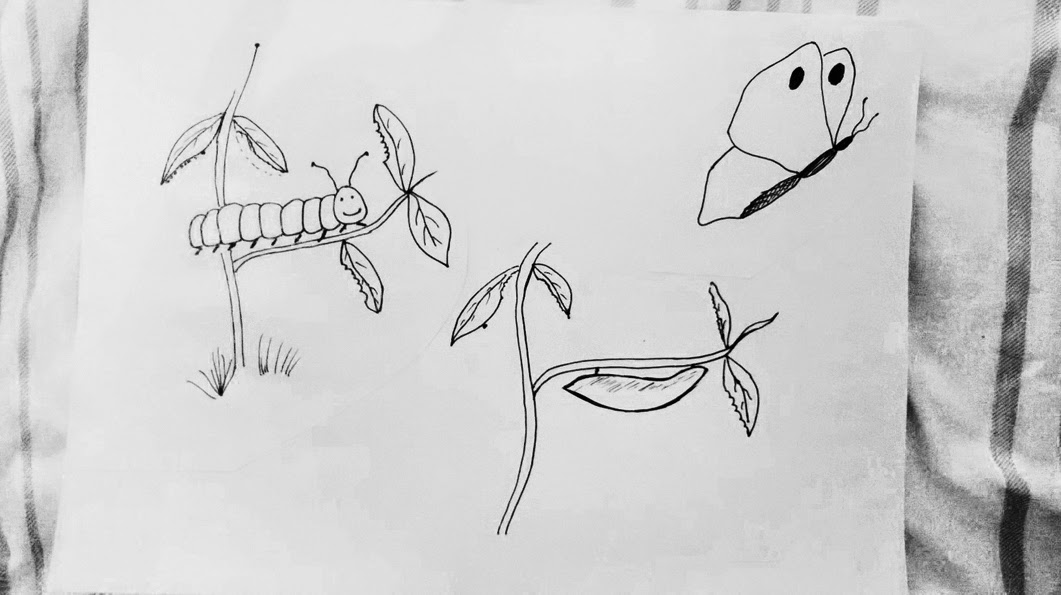
My three part drawing of this life cycle tells a story.  But looking at it now I can see many stories within it.  


It could be the story of the many CLDP students that I work with.  Coming to the programme hungry for knowledge, development and keen to develop their skills.  The pupa could be the reflection that they engage with during the programme.  And I certainly know many butterflies who have emerged & stretched their wings to go off and explore the world of L&D.  I am lucky to hear from many ex-students who continue to stay in contact and share their stories with me.

The butterfly’s story could be another way of looking at Harold Jarche’s Seek-Sense-Share model for PKM (Personal Knowledge Mastery).  The caterpillar is clearly in full ‘seek’ mode – curious & hungry - eating its way through all sorts of interesting blogs, tweets, posts, shares and likes.  Whilst in its cocoon, the pupa ‘senses’, filters, combines, contrasts, discerns before emerging to ‘share’ its unique wing patterns and take on the world.

Or it could be the story of my career – a keen & eager young L&Der devouring books, trying out new approaches – a very hungry caterpillar! Then feeling cocooned by the experience of motherhood and that desperate need to balance out competing priorities – safety, the need to earn and a limiting of professional challenges winning out.  But now – a new phase is entered on and I’m getting to spread my wings again!

What stories do you see in the butterfly’s experience?

Which brings me to jazz! Some years ago, I borrowed Toni Morrison’s novel ‘Jazz’ from my brother.  I thought it was going to be about jazz.  Then part way through, I had a Homer Simpson moment ‘Duh!’ – it wasn’t about jazz – it was jazz!  Toni Morrison had structured the novel just like a piece of jazz music, with the opening chapter providing an outline of the main elements of the story – the ‘head arrangement’ or ‘theme’ and then each subsequent chapter elaborating & improvising on this theme from the perspective of each of the key characters – a trumpet solo, sax solo, even the dreaded drum solo – if you like.  Just like with a piece of jazz music, we all have our own interpretations of our experiences or stories – sometimes we share an experience with friends, but still have our own perception of that story.  

That happened to me only this week.  In the course of a conversation, I suddenly felt the ground shift, bit like a minor shock from an earth tremor, as I suddenly shifted perspective and caught a glimpse of the world from another’s perspective.  A whole different story to mine.  Just for an instance.   

And as I reflected on this, I was able to see a new story for me.  I had been telling myself the story of my last few months in a particular way – with a particular narrative theme – it’s been a tough 18 months personally - but I could now hear it in a new way too.  A more resourceful, positive way. Like a jazz musician returning to a classic tune and finding new patterns, new depths, new ways of playing it.   

Like jazz musicians, we don’t have to play the same tunes in the same way – it is possible to do differently, improvise and hear fresh sounds.  We write our own music.

Butterflies.  Stories.  Change. And jazz!

Rachel Burnham
23 July 2014

Burnham L & D Consultancy helps L&D professionals become even more effective.  I am particularly interested in blended learning, the uses of social media for learning, evaluation and anything that improves the impact of learning on performance.
Follow me on Twitter @BurnhamLandD

Wednesday, July 9, 2014

Talent and the rest of us!


Talent and the rest of us!

Rachel Burnham writes: There was a lot of talk over the course of Wimbledon about ‘Talent’ and how best to manage it.  I have a confession – I hate the term ‘Talent’ and how it is often used in HR.  Clearly there are people with great talent – top tennis players come to mind, I have had the experience of working with some fabulous managers and I had the great pleasure of watching the undoubtedly talented Wynton Marsalis play the trumpet a couple of weeks ago at Manchester’s Bridgewater Hall.

What I dislike is the use of the term ‘Talent’ to refer to the ‘few’ within an organisation, in contrast to the rest of us – those of us who are doing the ‘grunt’ work – the great unwashed.

Notice who I identify with.  Not from any sense of false modesty.  I know have days when I am truly on form and in flow.  I can be spectacular at what I do.  When I am in rapport with the people I am working with.  When I am listening hard & well.  When the right questions come to mind.  When I listen to my heart and my head. When I whizz through the paperwork with focus & determination.

But, I also have days when I am really rather pedestrian.  When I talk too much.  When I am unfocused.  When I am a bit grumpy.  And when I am mean-spirited.  Fortunately, not usually all at the same time!  

I have worked hard over the years to enable me to be spectacular more of the time.  

And I have found ways to raise my own personal standards & skills, so that even on the not so great days, I can still be very good.

High performing organisations depend upon high performance, day in day out, by a great many people in all sorts of roles.  So why focus our attention only on the ‘few’?   Why have a performance management system as some organisations do, that insists on identifying a set percentage of people as under-performing? 

This kind of approach doesn’t fit with my experience of the huge potential that we all have within us – though I acknowledge that sometimes this can be well hidden!  The idea of the ‘few’ talented doesn’t sit well with my values - politically nor spiritually.

So much of what we look at in HR and L&D is about enabling people, so why adopt language and processes that implicitly write off most people?  Why not work to enable everyone to perform spectacularly, more of the time?


Rachel Burnham
9 July 2014

Burnham L & D Consultancy helps L&D professionals become even more effective.  I am particularly interested in blended learning, the uses of social media for learning, evaluation and anything that improves the impact of learning on performance.

Follow me on Twitter @BurnhamLandD

Friday, June 20, 2014

Review of 'Show Your Work' by Jane Bozarth


Review of ‘Show Your Work’ by Jane Bozarth

Rachel Burnham writes: I thought I would take a different approach to my review of Jane Bozarth’s book about ‘Working Out Loud’ or ‘Showing Your Work’ as she calls it and rather than write up my considered opinion, share with you my thoughts & feelings as I worked my way through the book.  So this is my ‘Working Out Loud’ style review. I hope you find it useful.

Day 1 – First impressions
Widely excited on opening my parcel – the book looks visually stunning with a great look & feel.  The bright blocks of colours and images immediately feel enticing – I want to start reading right now!  It feels like a coffee-table book – I experience a fleeting regret at not having a posh reception area to display such a fancy book in!

As I flick through the book, I can see that it is full of examples of people showing their work.  They seem to be from lots of different fields, so there should be something that everyone can relate to.   I’m excited and filled with anticipation – this is not like a text book.   Plus, I defy anyone to not love a book with images of ladybirds in it.

Day 2 – Back for a second look
This time I do start reading and work my way through the first three introductory sections.  These explain what ‘Showing Your work’ or ‘Working Out Loud’ is and set out the benefits both for organisations and individuals.  As I have already bought into this idea, most of this material is already familiar to me, but it would be essential background for those brand new to the topic.     

There are some great diagrams included to expand on points –  I find it very frustrating that a useful-looking diagram on ‘where to share when @ work?’ is reproduced so small, so that I cannot manage to read all the detail it includes.   I start to feel increasingly irritated by finding sections printed in white on a grey background in too small a font, which I just can’t read! Only had my eye test a few weeks ago, so doubt that it is me.  Want to lap it all up and now I can’t! 

Much of the material on reflecting won’t be new to many in L&D, but it is useful to see it linked in to the idea of Working Out Loud and it will help some to find their way in to this newer approach.

Feeling noticeably less enthusiastic after today’s reading session.

Day 3 – Reading through
The fourth section explores different ideas of what knowledge is and how our ideas of this impact of what we think of the concept of ‘Showing Our Work’.   Again, most of this is not new, but it does help to connect the practice of ‘Showing Our Work’ to the wider practice of knowledge management.

The next and largest section very quickly becomes my favourite section so far.  It includes a multiplicity of examples of people ‘Working Out Loud’ – some of these examples are reproduced in full, whilst others are short illustrations designed to inspire curiosity.   I particularly enjoy the extended example of a teacher using the RSA Animate idea as a project in a school to aid young people to develop their skills in reading & understanding a text by telling a story.   It is great to hear the teacher sharing their ups and downs through this project, identifying what worked and also what didn’t go so well, plus their ideas for improving it further - this is the heart of ‘Showing Your Work’.  And this story immediately gets me talking with some friends who do creative projects in schools about what they do & why – raising curiosity and encouraging collaboration are also just what ‘Showing Your Work’ leads to.

Another great aspect of these examples is that they illustrate both different ways of recording & sharing your ‘Working Out Loud’ and also support different reasons for choosing to ‘Work Out Loud’ eg to aid others learning the same task, to inspire others, to break down misunderstanding about roles, to see help with challenges.

I’m feeling inspired again, but also have a much clearer idea of some of the different ways that I could be using ‘Working Out Loud’.

Day 4 – Digging Deeper
I finish off reading the rest of this major section and look back over it – it does include a great range of examples.  I am conscious that I have read some of these before and that you could therefore get a good idea of what ‘Showing Your Work’ is from material readily available via the internet, which may well be enough to inform & inspire some people.  However, the book adds depth and breadth which will be of value in some organisations.

I move onto reading a section on how the L&D team can get involved in encouraging ‘Showing Your Work’ which again sets out lots of ways to make a start on this and challenges L&D to act as a role-model.

I am now so filled with enthusiasm, that I can’t help getting the book out to show a fellow L&Der whilst meeting for coffee.

Day 5 – Nearly home!
I begin reading the final section and explore a super listing of practical ways to get started with implementation.   But I find this final section less coherent and it seems to duplicate material from earlier in the book.   

The fifth & sixth sections which are packed full of examples and challenge L&D are definitely practical, inspiring and I am so glad I have them to refer back to.  I’m less convinced by the rest of the book.

Perry Timms in an exchange on Twitter asked me if I thought the book was worth the price.  I paid £22.09, so this is a question well worth asking.  I give it a ‘qualified-thumbs up’ – if you have a team who are comfortable with learning from the internet and who experiment with new ideas willingly, then you could save your money.  But if your team need some encouragement and ginger-bread crumbs, then this would be a great aid.

‘Show Your Work’ by Jane Bozarth 2014 Published by Wiley

Rachel Burnham
20 June 2014
Burnham L & D Consultancy specialises in the development of L&D professionals, blended learning and evaluation
Follow me on Twitter @BurnhamLandD