Wednesday, July 23, 2014

Butterflies, Stories, Change, Jazz


Butterflies, Stories, Change, Jazz


Rachel Burnham writes: Ever since I saw a wonderful photograph of a butterfly taken by Doug Shaw at the weekend and was in turn encouraged by him to photograph the ones at our allotment, I can’t get butterflies out of my mind.  Their wonderful flowing shapes, the variety of colours and patterns, the way they move, the contrasting textures between wings and body.  Butterflies on the brain!

And of course, it isn’t just their shape that inspires and entrances – they are so evocative in the way they represent ideas of change, personal growth and transformation.  It is easy to connect with butterflies – many of us will have as children folded a sheet of paper in two, placed splodges of paint and amazingly a butterfly emerged. Or again folded a paper in two and cut shapes out to create an outline of a butterfly.  Some of us may have repeated the process with our own children. You, like me, may even have studied the life cycle of the butterfly in Biology lessons.

I have my own butterfly story.  Many years ago, I represented the United Reformed Church at the Assembly of the World Council of Churches – it was a wonderful experience.  One of the things I remember from it was a huge artwork that hung at the back of the Assembly hall – it was an enormous patchwork made up of many, many pieces each made by a different church congregation in the host country, all illustrating the theme of the event.  At the close of the Council, the pieces were all untied and each one given to a delegate to take back to their own church.  My piece for my then church at High Cross, Tottenham was a beautifully appliqued butterfly – in this case representing ‘New Life’ or ‘New Beginnings’.

My three part drawing of this life cycle tells a story.  But looking at it now I can see many stories within it.  
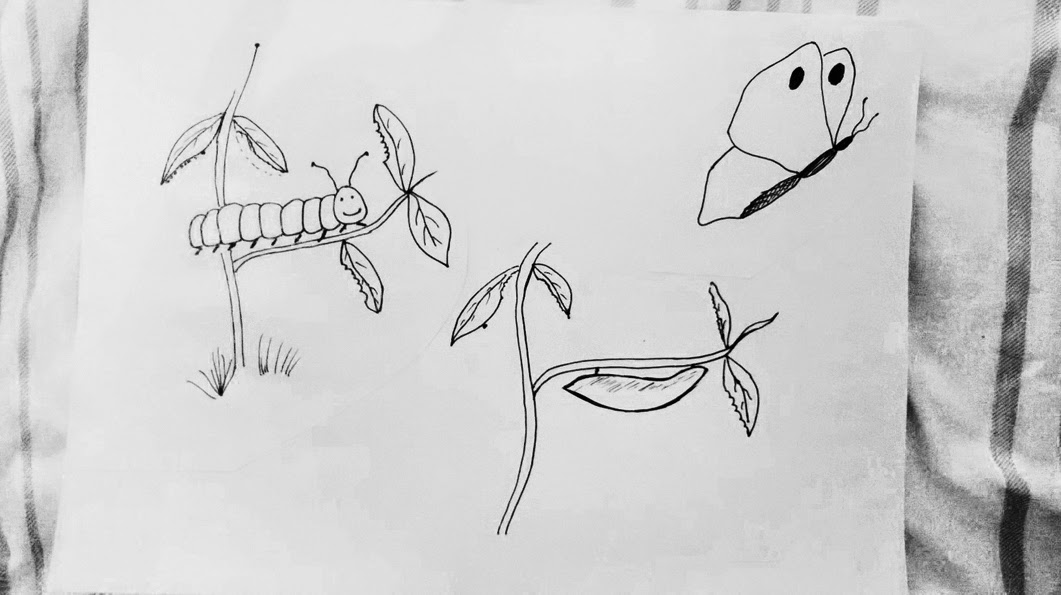


It could be the story of the many CLDP students that I work with.  Coming to the programme hungry for knowledge, development and keen to develop their skills.  The pupa could be the reflection that they engage with during the programme.  And I certainly know many butterflies who have emerged & stretched their wings to go off and explore the world of L&D.  I am lucky to hear from many ex-students who continue to stay in contact and share their stories with me.

The butterfly’s story could be another way of looking at Harold Jarche’s Seek-Sense-Share model for PKM (Personal Knowledge Mastery).  The caterpillar is clearly in full ‘seek’ mode – curious & hungry - eating its way through all sorts of interesting blogs, tweets, posts, shares and likes.  Whilst in its cocoon, the pupa ‘senses’, filters, combines, contrasts, discerns before emerging to ‘share’ its unique wing patterns and take on the world.

Or it could be the story of my career – a keen & eager young L&Der devouring books, trying out new approaches – a very hungry caterpillar! Then feeling cocooned by the experience of motherhood and that desperate need to balance out competing priorities – safety, the need to earn and a limiting of professional challenges winning out.  But now – a new phase is entered on and I’m getting to spread my wings again!

What stories do you see in the butterfly’s experience?

Which brings me to jazz! Some years ago, I borrowed Toni Morrison’s novel ‘Jazz’ from my brother.  I thought it was going to be about jazz.  Then part way through, I had a Homer Simpson moment ‘Duh!’ – it wasn’t about jazz – it was jazz!  Toni Morrison had structured the novel just like a piece of jazz music, with the opening chapter providing an outline of the main elements of the story – the ‘head arrangement’ or ‘theme’ and then each subsequent chapter elaborating & improvising on this theme from the perspective of each of the key characters – a trumpet solo, sax solo, even the dreaded drum solo – if you like.  Just like with a piece of jazz music, we all have our own interpretations of our experiences or stories – sometimes we share an experience with friends, but still have our own perception of that story.  

That happened to me only this week.  In the course of a conversation, I suddenly felt the ground shift, bit like a minor shock from an earth tremor, as I suddenly shifted perspective and caught a glimpse of the world from another’s perspective.  A whole different story to mine.  Just for an instance.   

And as I reflected on this, I was able to see a new story for me.  I had been telling myself the story of my last few months in a particular way – with a particular narrative theme – it’s been a tough 18 months personally - but I could now hear it in a new way too.  A more resourceful, positive way. Like a jazz musician returning to a classic tune and finding new patterns, new depths, new ways of playing it.   

Like jazz musicians, we don’t have to play the same tunes in the same way – it is possible to do differently, improvise and hear fresh sounds.  We write our own music.

Butterflies.  Stories.  Change. And jazz!

Rachel Burnham
23 July 2014

Burnham L & D Consultancy helps L&D professionals become even more effective.  I am particularly interested in blended learning, the uses of social media for learning, evaluation and anything that improves the impact of learning on performance.
Follow me on Twitter @BurnhamLandD

Wednesday, July 9, 2014

Talent and the rest of us!


Talent and the rest of us!

Rachel Burnham writes: There was a lot of talk over the course of Wimbledon about ‘Talent’ and how best to manage it.  I have a confession – I hate the term ‘Talent’ and how it is often used in HR.  Clearly there are people with great talent – top tennis players come to mind, I have had the experience of working with some fabulous managers and I had the great pleasure of watching the undoubtedly talented Wynton Marsalis play the trumpet a couple of weeks ago at Manchester’s Bridgewater Hall.

What I dislike is the use of the term ‘Talent’ to refer to the ‘few’ within an organisation, in contrast to the rest of us – those of us who are doing the ‘grunt’ work – the great unwashed.

Notice who I identify with.  Not from any sense of false modesty.  I know have days when I am truly on form and in flow.  I can be spectacular at what I do.  When I am in rapport with the people I am working with.  When I am listening hard & well.  When the right questions come to mind.  When I listen to my heart and my head. When I whizz through the paperwork with focus & determination.

But, I also have days when I am really rather pedestrian.  When I talk too much.  When I am unfocused.  When I am a bit grumpy.  And when I am mean-spirited.  Fortunately, not usually all at the same time!  

I have worked hard over the years to enable me to be spectacular more of the time.  

And I have found ways to raise my own personal standards & skills, so that even on the not so great days, I can still be very good.

High performing organisations depend upon high performance, day in day out, by a great many people in all sorts of roles.  So why focus our attention only on the ‘few’?   Why have a performance management system as some organisations do, that insists on identifying a set percentage of people as under-performing? 

This kind of approach doesn’t fit with my experience of the huge potential that we all have within us – though I acknowledge that sometimes this can be well hidden!  The idea of the ‘few’ talented doesn’t sit well with my values - politically nor spiritually.

So much of what we look at in HR and L&D is about enabling people, so why adopt language and processes that implicitly write off most people?  Why not work to enable everyone to perform spectacularly, more of the time?


Rachel Burnham
9 July 2014

Burnham L & D Consultancy helps L&D professionals become even more effective.  I am particularly interested in blended learning, the uses of social media for learning, evaluation and anything that improves the impact of learning on performance.

Follow me on Twitter @BurnhamLandD


Friday, June 20, 2014

Review of 'Show Your Work' by Jane Bozarth


Review of ‘Show Your Work’ by Jane Bozarth

Rachel Burnham writes: I thought I would take a different approach to my review of Jane Bozarth’s book about ‘Working Out Loud’ or ‘Showing Your Work’ as she calls it and rather than write up my considered opinion, share with you my thoughts & feelings as I worked my way through the book.  So this is my ‘Working Out Loud’ style review. I hope you find it useful.

Day 1 – First impressions
Widely excited on opening my parcel – the book looks visually stunning with a great look & feel.  The bright blocks of colours and images immediately feel enticing – I want to start reading right now!  It feels like a coffee-table book – I experience a fleeting regret at not having a posh reception area to display such a fancy book in!

As I flick through the book, I can see that it is full of examples of people showing their work.  They seem to be from lots of different fields, so there should be something that everyone can relate to.   I’m excited and filled with anticipation – this is not like a text book.   Plus, I defy anyone to not love a book with images of ladybirds in it.

Day 2 – Back for a second look
This time I do start reading and work my way through the first three introductory sections.  These explain what ‘Showing Your work’ or ‘Working Out Loud’ is and set out the benefits both for organisations and individuals.  As I have already bought into this idea, most of this material is already familiar to me, but it would be essential background for those brand new to the topic.     

There are some great diagrams included to expand on points –  I find it very frustrating that a useful-looking diagram on ‘where to share when @ work?’ is reproduced so small, so that I cannot manage to read all the detail it includes.   I start to feel increasingly irritated by finding sections printed in white on a grey background in too small a font, which I just can’t read! Only had my eye test a few weeks ago, so doubt that it is me.  Want to lap it all up and now I can’t! 

Much of the material on reflecting won’t be new to many in L&D, but it is useful to see it linked in to the idea of Working Out Loud and it will help some to find their way in to this newer approach.

Feeling noticeably less enthusiastic after today’s reading session.

Day 3 – Reading through
The fourth section explores different ideas of what knowledge is and how our ideas of this impact of what we think of the concept of ‘Showing Our Work’.   Again, most of this is not new, but it does help to connect the practice of ‘Showing Our Work’ to the wider practice of knowledge management.

The next and largest section very quickly becomes my favourite section so far.  It includes a multiplicity of examples of people ‘Working Out Loud’ – some of these examples are reproduced in full, whilst others are short illustrations designed to inspire curiosity.   I particularly enjoy the extended example of a teacher using the RSA Animate idea as a project in a school to aid young people to develop their skills in reading & understanding a text by telling a story.   It is great to hear the teacher sharing their ups and downs through this project, identifying what worked and also what didn’t go so well, plus their ideas for improving it further - this is the heart of ‘Showing Your Work’.  And this story immediately gets me talking with some friends who do creative projects in schools about what they do & why – raising curiosity and encouraging collaboration are also just what ‘Showing Your Work’ leads to.

Another great aspect of these examples is that they illustrate both different ways of recording & sharing your ‘Working Out Loud’ and also support different reasons for choosing to ‘Work Out Loud’ eg to aid others learning the same task, to inspire others, to break down misunderstanding about roles, to see help with challenges.

I’m feeling inspired again, but also have a much clearer idea of some of the different ways that I could be using ‘Working Out Loud’.

Day 4 – Digging Deeper
I finish off reading the rest of this major section and look back over it – it does include a great range of examples.  I am conscious that I have read some of these before and that you could therefore get a good idea of what ‘Showing Your Work’ is from material readily available via the internet, which may well be enough to inform & inspire some people.  However, the book adds depth and breadth which will be of value in some organisations.

I move onto reading a section on how the L&D team can get involved in encouraging ‘Showing Your Work’ which again sets out lots of ways to make a start on this and challenges L&D to act as a role-model.

I am now so filled with enthusiasm, that I can’t help getting the book out to show a fellow L&Der whilst meeting for coffee.

Day 5 – Nearly home!
I begin reading the final section and explore a super listing of practical ways to get started with implementation.   But I find this final section less coherent and it seems to duplicate material from earlier in the book.   

The fifth & sixth sections which are packed full of examples and challenge L&D are definitely practical, inspiring and I am so glad I have them to refer back to.  I’m less convinced by the rest of the book.

Perry Timms in an exchange on Twitter asked me if I thought the book was worth the price.  I paid £22.09, so this is a question well worth asking.  I give it a ‘qualified-thumbs up’ – if you have a team who are comfortable with learning from the internet and who experiment with new ideas willingly, then you could save your money.  But if your team need some encouragement and ginger-bread crumbs, then this would be a great aid.

‘Show Your Work’ by Jane Bozarth 2014 Published by Wiley

Rachel Burnham
20 June 2014
Burnham L & D Consultancy specialises in the development of L&D professionals, blended learning and evaluation
Follow me on Twitter @BurnhamLandD

Monday, June 9, 2014

Questions, Questions, Questions?


Questions, Questions, Questions?

Rachel Burnham writes: A common misconception I notice amongst many people new to designing & delivering training is to see training as primarily made up of presentations or talks. Many new to Learning & Development also feel that it would be easier to deliver a presentation rather than involve learners in activities.  

Learning is always more effective when learners are actively involved throughout the process whether in identifying the need, choosing learning methods, engaging with the material or evaluating the value of the learning.  And involving learners in a face to face session from early on is a very effective strategy for taking the pressure off yourself if you are new to delivery or feeling nervous at the thought of all eyes on you!

This blog focuses on the value of asking questions as a simple way to get learners involved in training sessions.  

Questions are a very flexible set of tools.  Making even better use of questions is often an easy way of improving the effectiveness of group training sessions or workshops.  Questionning is also key to many other learning methods from coaching to action learning sets. 
 
Last week I did a very simple exercise as part of a ‘Train the Trainer’ programme I was facilitating, I asked the group to note down all the different reasons that you might ask questions to participants as a trainer.   And between us, we very quickly came up with over 20 reasons for asking questions – ranging from the simplistic – ‘to find out a participant’s name’ through ‘to deepen & challenge participants’ learning’ and to ‘encourage use of the learning in the workplace’.

I think that these reasons for asking questions can be grouped  into three broad areas:

  • Asking questions to develop rapport with learners – finding out information to enable you to get to know the participants better and tailor the learning even more closely to their needs.  Questions about job role & responsibilities, previous experience (good & more challenging), hopes & fears for the training can all help with this.

  •   Asking questions to involve participants & manage the group – questions which raise curiosity, get participants thinking & sharing from their own experience and get the group discussing & looking at the topic from different angles all play a part.  You can use questions to draw in quieter group members, to draw out & value the experience of individuals and to keep the focus of the learning.

  •  Asking questions to assess and evaluate the learning – there are so many ways to use questions to informally assess learning both during and towards the end of a programme.   Questions can be used to encourage recall & recap learning, to review learning objectives, to identify unexpected learning, to aid planning the use of learning and to encourage self-reflection.  We can seek out feedback on what worked in the training and what we can further improve.


Of course, the questions don’t have to be all one way.  Questions from learners will add further relevancy and immediacy to the session.  Participants who ask questions are worth their weight in gold because they enable you to engage with what is on their mind and with their way of seeing the world.

Invite participants at the start of the session to jot down the questions they would like to be able to answer in relation to the topic – this is another way of getting learners involved in setting the objectives for the session.  Encourage learners to reflect on what questions they have throughout the session & give sufficient time to this – perhaps encouraging paired work to identify these.  Get participants to generate their own questions for inclusion in a knowledge check quiz.

There are times when it is good to hold back from asking questions eg if participants are involved in a group activity and by asking ‘How are you getting on?’ you will break the conversation flow – but overall more questions and more effective questions will lead to more effective learning.  But do give time for responses and do listen to those responses.

If you are new to design & delivery, one tip to encourage you to make more use of questions is to prepare some questions and include them in you session plan or notes. You may not use these exact questions when it comes to facilitating the session, but you are more likely to make good use of questions if you have begun thinking about this in advance.  Where there are specific factual answers to those questions, make sure you include these in your notes – particularly if these are to be used by other trainers as well as yourself.

So, I leave you with some questions (of course) to ponder:

  • How do you make use of questions in sessions you design or deliver?  
  • Are there any gaps in how you are using questions at present? 
  • What value do questions bring to your sessions – for you & for participants?  How can you build further on that?


Rachel Burnham
9 June 2014

Burnham L & D Consultancy specialises in the development of L&D professionals, blended learning and evaluation
Follow me on Twitter @BurnhamLandD